
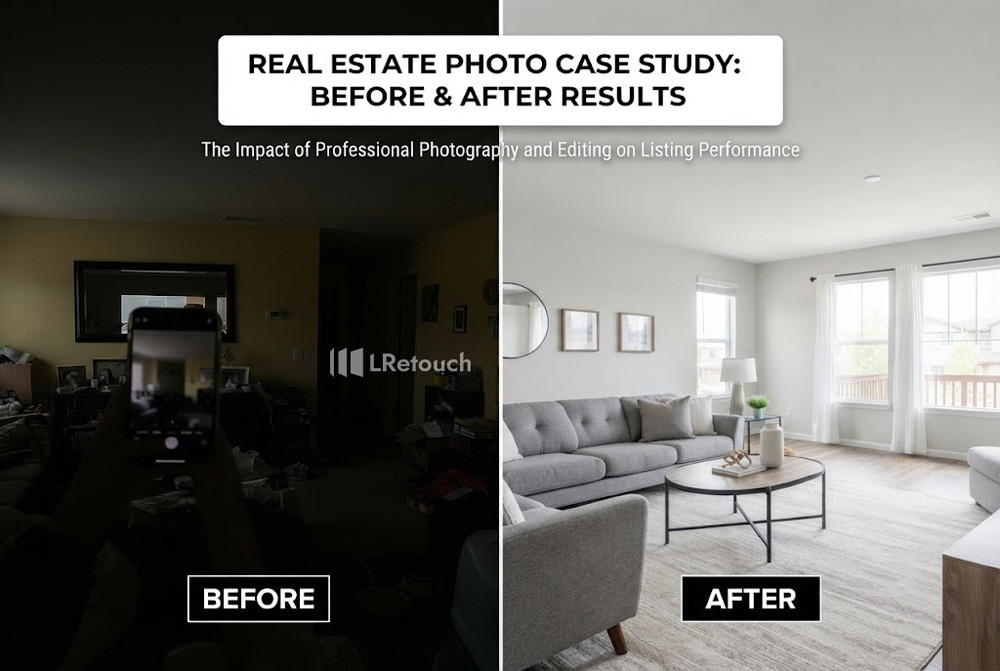
A real estate photo case study shows how better listing images can improve buyer attention and support faster sales. Photos are often the first experience buyers have with a property online. Strong images can increase interest before a buyer ever schedules a showing.
Real Estate Photo Case Study: The Listing Before and After
Consider a fictional suburban property listed at $625,000.
The home has four bedrooms, three bathrooms, and a renovated kitchen. It also has a large backyard and an attractive front exterior.
The property itself is strong. However, the original listing photos do not show it well.
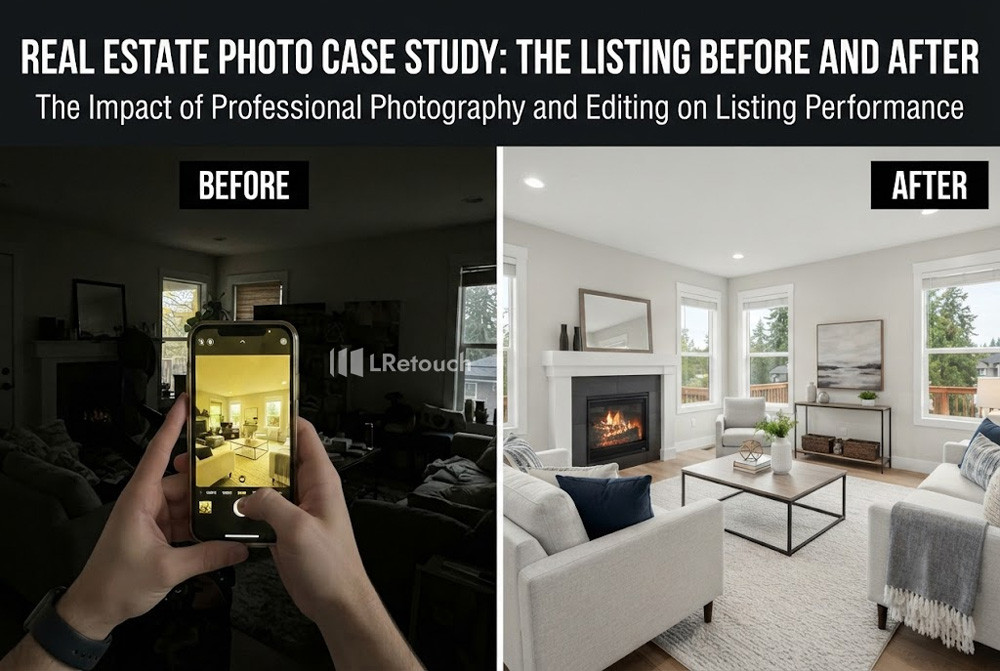
The agent used smartphone photos for the first listing launch. Several images had poor lighting and uneven color. Some rooms also looked smaller than they were.
The Listing Before and After
Before the photo improvements
The initial listing had these problems:
- Dark interior rooms
- Uneven white balance
- Distracting objects
- Weak exterior lighting
- Limited room angles
- Poor visual consistency
- No strong lead image
- Little focus on key selling features
The listing remained online for several weeks with limited engagement.
The agent then scheduled professional photography. The new images used better composition, natural lighting, and stronger angles.
Professional editing followed the shoot.
Editors corrected exposure and color. They also removed minor distractions without changing the property’s actual features.
After the photo improvements
The revised listing presented the home more clearly.
The living room looked brighter and more spacious. The kitchen showed its renovation details more effectively.
The exterior image also created a stronger first impression.
The agent could then create before after property sales comparisons for internal marketing analysis.
For this illustrative case, assume these results:
| Metric | Before | After |
| Listing views | 1,200 | 2,050 |
| Showing requests | 8 | 15 |
| Average weekly inquiries | 3 | 7 |
| Days before accepted offer | 42 | 24 |
These figures are examples for explaining the process. They do not represent a verified property transaction.
The important point is the measurement process.
Agents should compare actual listing performance before claiming that photography caused faster sales.
How Better Images Can Improve Listing Conversion
Good real estate photography does not guarantee a faster sale.
Price, location, property condition, inventory, and market conditions still matter.
However, better images can improve the first stage of the sales funnel.
That stage is getting buyers to notice and investigate the property.
Use listing conversion images strategically
Not every image should have the same purpose.
A strong listing should guide buyers through the property.
How Better Images Can Improve Listing Conversion
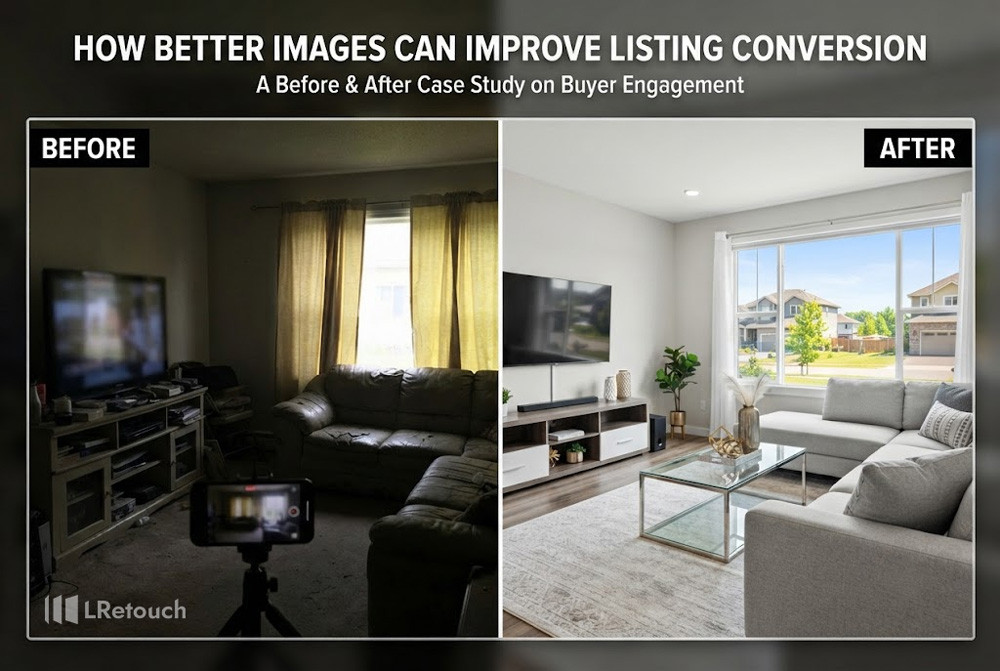
Useful listing conversion images can include:
- A bright exterior hero image
- A wide living room view
- A detailed kitchen photo
- A primary bedroom image
- A bathroom feature shot
- A backyard or patio image
- A neighborhood or view image
- A floor-plan image when available
Each image should answer a buyer question.
The living room shows space. The kitchen shows finishes. The backyard shows lifestyle potential.
This approach creates a more complete visual story.
Editing can strengthen the presentation
Professional editing can improve consistency across an entire photo set.
Common adjustments include:
- Exposure correction
- White balance correction
- Color enhancement
- Window view balancing
- Shadow recovery
- Perspective correction
- Object removal
- Sky replacement when appropriate
However, editing should remain realistic.
NAR has recently highlighted concerns about heavily enhanced listing photos. Buyers can feel misled when online images differ greatly from the actual property.
A successful real estate success story should therefore focus on accurate presentation.
The goal is not to create a different property.
The goal is to show the real property at its best.
Track the photo impact on sales
A useful marketing case study should measure more than final sale price.
Agents can track:
- Listing views
- Saves
- Shares
- Showing requests
- Inquiry volume
- Time to first showing
- Days on market
- Offer volume
- Final sale price
These metrics create a clearer picture of photo impact sales.
For example, an agent may discover that new photography doubled listing views.
That does not prove photography alone caused a sale.
But it provides useful evidence about changes in buyer engagement.
Professional photography and buyer expectations
Visual quality can also affect expectations.
A polished listing may encourage more buyers to explore the property. But unrealistic images can create disappointment.
NAR reported that 81% of buyers considered listing photos the most important feature when evaluating properties in research discussed in 2026.
That makes accuracy especially important.
Good photography should attract attention without creating false expectations.
Building a Repeatable Photo Editing and Marketing Workflow
A single successful listing is useful.
A repeatable workflow is more valuable for agents handling many properties.
This is where professional editing support can become important.

Building a Repeatable Photo Editing and Marketing Workflow
Step 1: Plan the photography
Start with the property’s strongest features.
Identify the rooms and exterior areas that deserve priority.
Create a shot list before the photographer arrives.
This reduces missed opportunities.
Step 2: Capture consistent images
Use professional equipment and appropriate lighting.
Capture multiple angles when room size or layout needs explanation.
Keep vertical lines straight when possible.
Consistency helps the final gallery feel professional.
Step 3: Edit the complete photo set
After the shoot, send the images for editing.
A bulk photo editing service can process large batches for agents, photographers, and real estate teams.
This can help when a listing contains 30, 50, or more images.
Editors can apply consistent adjustments across the complete gallery.
This is especially useful for teams handling multiple listings every week.
Step 4: Add other visual marketing assets
Photography does not have to work alone.
Agents can combine listing photos with floor plans, virtual tours, and video.
NAR’s 2025 data shows that 57% of internet-using buyers rated floor plans very useful. Virtual tours received a 41% rating.
Video can also extend the reach of a listing.
A real estate video editing service can turn raw footage into short property tours, social clips, and promotional videos.
This creates more content from the same property shoot.
Step 5: Compare results
The final step is measurement.
Compare similar listings whenever possible.
For example, an agent could compare two properties in the same area.
Both properties have similar prices and features.
One uses professional photography. The other uses basic listing images.
The agent can then compare views, saves, inquiries, showings, and time to offer.
This creates a more useful real estate photo case study.
It also helps the agent make better marketing decisions over time.
Why outsourcing can help photographers
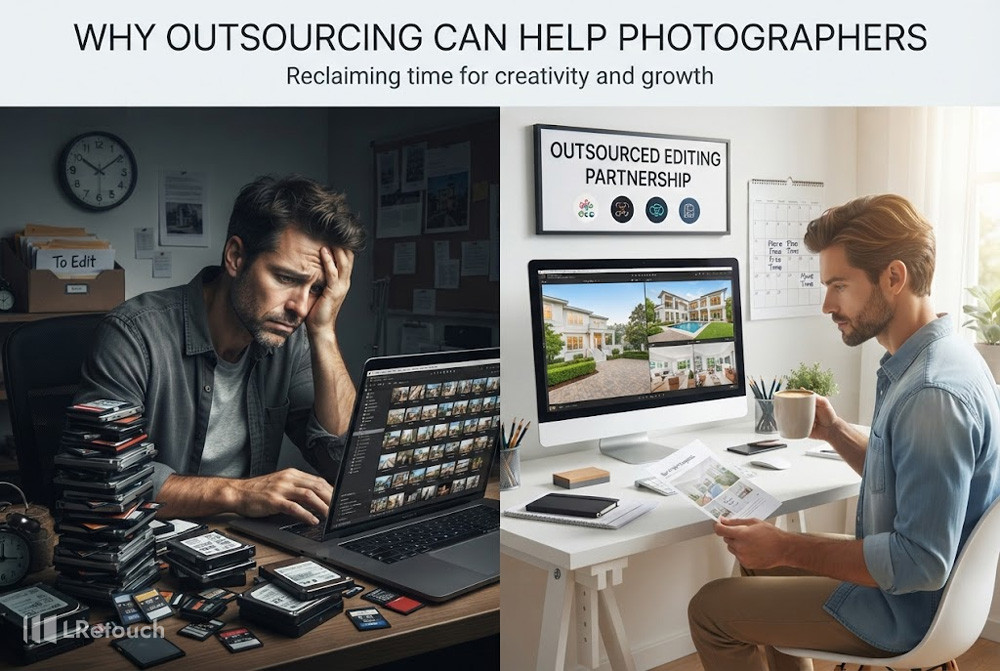
Photographers often spend significant time editing after each shoot.
That time can reduce their capacity for new assignments.
Photo editing for photographers can move repetitive post-production tasks to an editing team.
The photographer can then focus more on shooting, client communication, and business development.
Why outsourcing can help photographers
For agencies, bulk editing can provide another advantage.
It creates a consistent visual style across many listings.
That consistency can strengthen the agency’s overall brand.
What this case study really shows
Better photos are not a magic solution.
They cannot fix an overpriced property or weak market demand.
However, strong images can improve how a property is presented online.
That can influence the early stages of buyer engagement.
The strongest strategy combines:
- Accurate professional photography
- Consistent editing
- Strong image selection
- Clear property descriptions
- Floor plans and video
- Fast listing publication
- Performance tracking
This creates a complete visual marketing system.
Conclusion
This real estate photo case study shows how stronger images can improve listing presentation and buyer engagement. Better photography does not guarantee faster sales, but it can strengthen the first impression and support a more effective marketing strategy.