
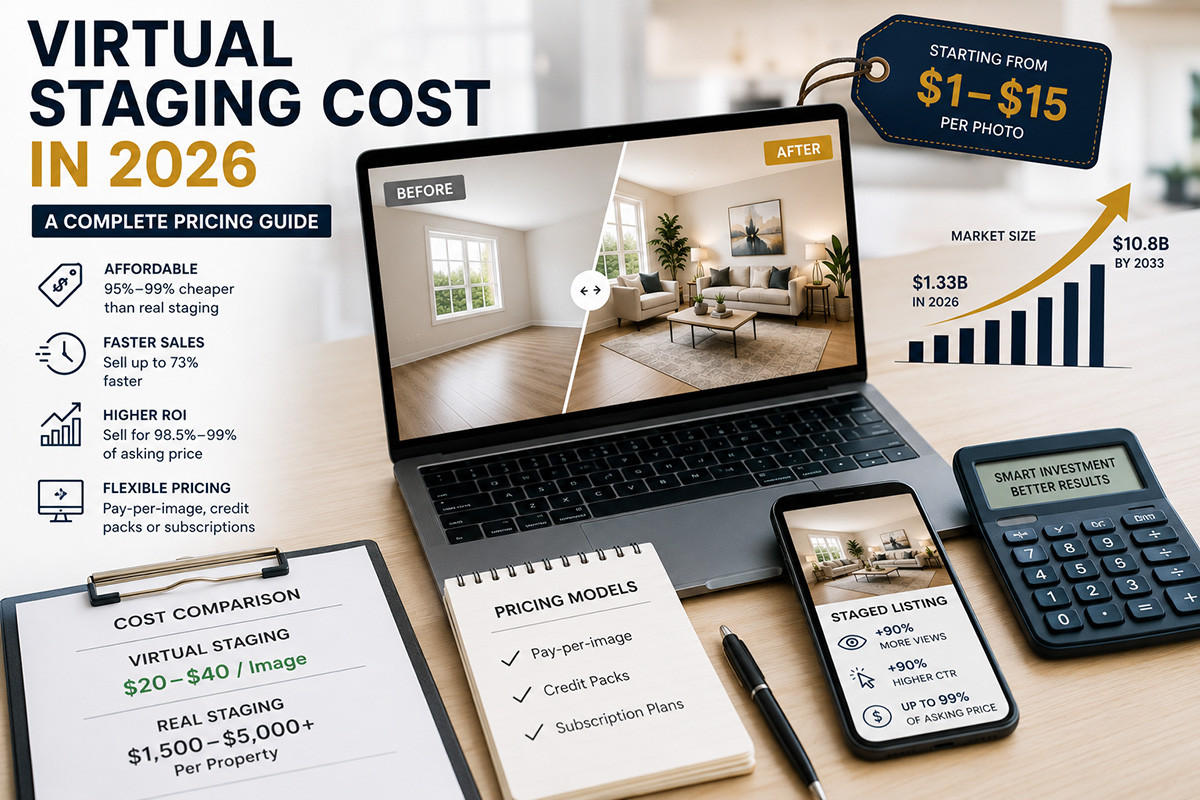
Virtual staging cost is becoming a key factor for home sellers, agents, and investors comparing digital staging with traditional furnishing. As AI-assisted workflows expand and service packages diversify, prices vary by image count, room complexity, turnaround time, and revision needs. How much does it cost in 2026 and which hidden costs need to be watched for? Keep reading this post.
Overview
Virtual staging is rapidly reshaping real estate marketing, offering significant advantages over traditional methods. When comparing virtual staging vs real staging, the data clearly shows a strong shift toward digital solutions driven by cost savings, speed, and performance.
- Rapid market expansion
The virtual staging industry has grown to approximately $1.33 billion in 2026, with forecasts suggesting it could reach $10.8 billion by 2033, reflecting strong global adoption in real estate marketing.
- Significant cost reduction
Compared to physical staging, virtual staging is 95%–99% more affordable, with AI-powered solutions starting as low as $1–$15 per photo, making it highly scalable for agents and property managers.
- Faster property sales
Listings enhanced with staging visuals tend to sell much quicker, reducing average time on market from around 52 days down to 29–31 days, representing up to 73% faster sales cycles.
- Higher selling performance
Virtually staged homes often achieve 98.5%–99% of asking price, compared to 96%–97% for unstaged properties, showing a clear impact on final sale value.
- Stronger buyer engagement
Staged listings generate around 90% higher click-through rates and up to 70% more time spent on listing pages, especially since 96% of buyers begin their search online.
Overall, the comparison of virtual staging vs real staging highlights why digital staging has become a preferred strategy for faster, more cost-effective, and higher-performing property sales.
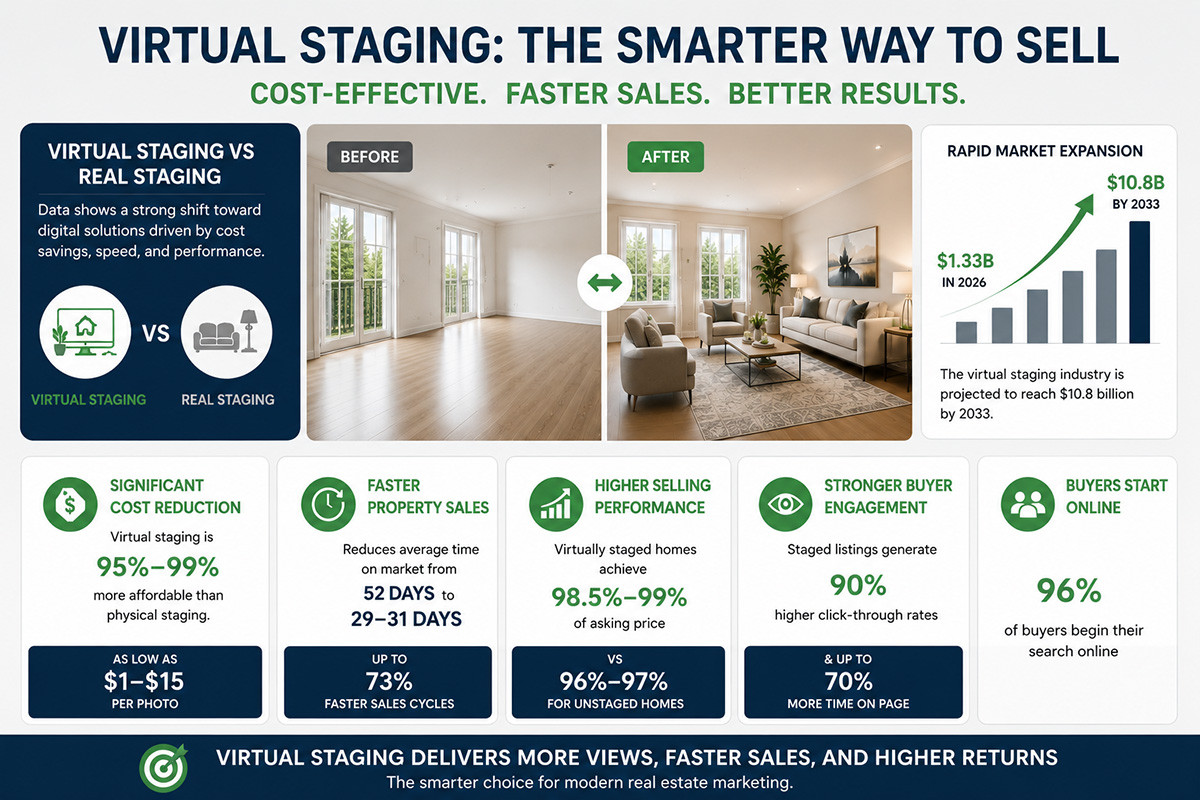
Virtual staging is transforming real estate marketing by reducing costs, accelerating sales, increasing buyer engagement, and delivering higher ROI compared to traditional staging methods.
Virtual staging cost models explained
Providers generally use three main approaches to price virtual staging services:
Pay-per-image
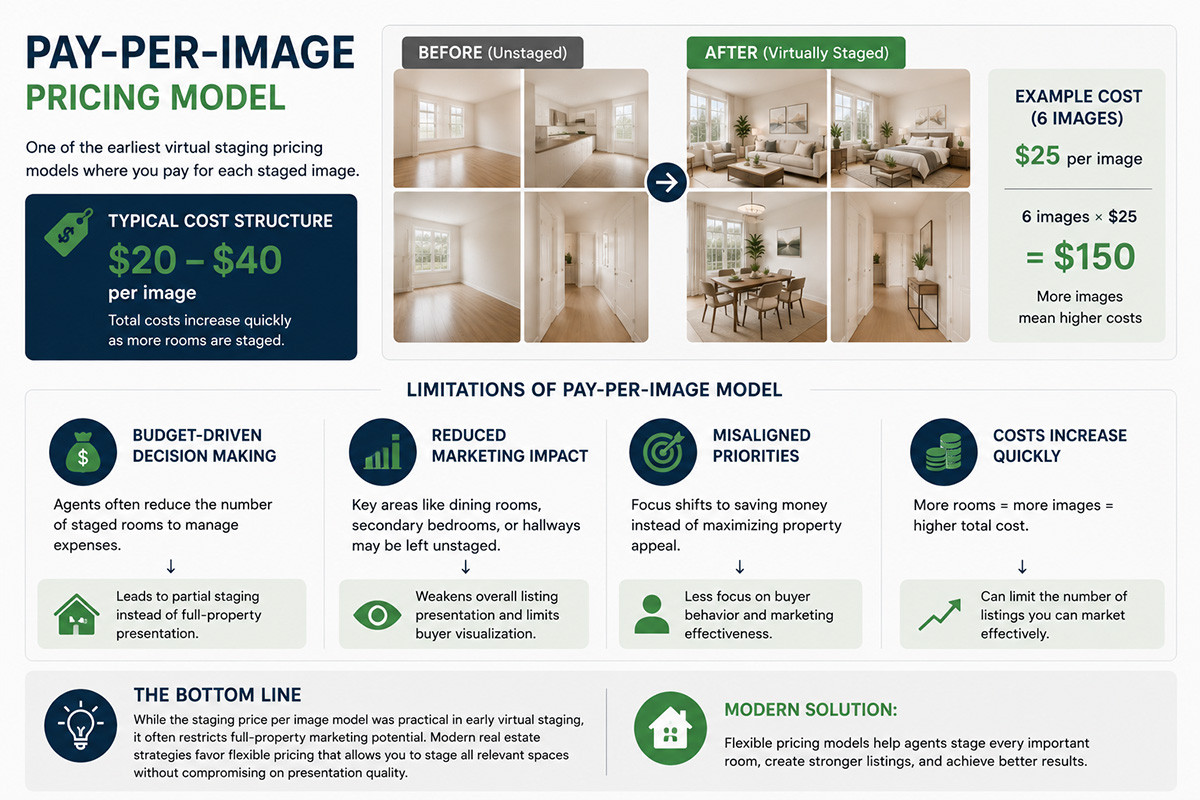
The per-image pricing model is one of the earliest approaches used in virtual staging services. Charging per image accurately reflected production effort and costs.
However, this model has clear limitations when evaluated from a modern marketing perspective:
- Typical cost structure
The staging price per image usually ranges from $20 to $40 per photo, meaning total costs increase quickly as more rooms are staged.
- Budget-driven decision making
Because pricing is tied to each photo, agents often reduce the number of staged rooms to manage expenses. This leads to partial staging instead of full-property presentation.
- Reduced marketing impact
When costs influence strategy, key areas like dining rooms, secondary bedrooms, or hallways may be left unstaged. This weakens overall listing presentation and limits buyer visualization.
- Misaligned priorities
Ideally, staging decisions should focus on buyer behavior and marketing effectiveness. Instead, the per-image model can shift attention toward saving money rather than maximizing property appeal.
While the staging price per image model was practical in early virtual staging, it often restricts full-property marketing potential. Modern real estate strategies increasingly favor more flexible pricing structures that allow agents to stage all relevant spaces without compromising on presentation quality.
Pay per image
Credit packs
Instead of paying per photo, many platforms offer staging packages where users purchase credits in bulk and use them to stage multiple listing images. This approach is designed to reduce cost per image while giving real estate agents more flexibility in managing larger property portfolios.
Typical staging packages structure
| Package | Price | Credits | Estimated Usage |
| Nano package | $12 | 150 credits | ~35–70 images |
| Mini package | $30 | 400 credits | ~100–200 images |
| Medium package | $100 | 1,400 credits | ~350–700 images |
| Max package | $500 | 8,000 credits | ~2,000–4,000 images |
With these staging packages, the effective cost per image drops to approximately $0.12–$0.16, making it significantly more affordable than traditional pricing models. This structure is especially beneficial for active real estate agents who regularly stage five or more properties each month, as it allows them to scale marketing efforts without worrying about individual image costs.
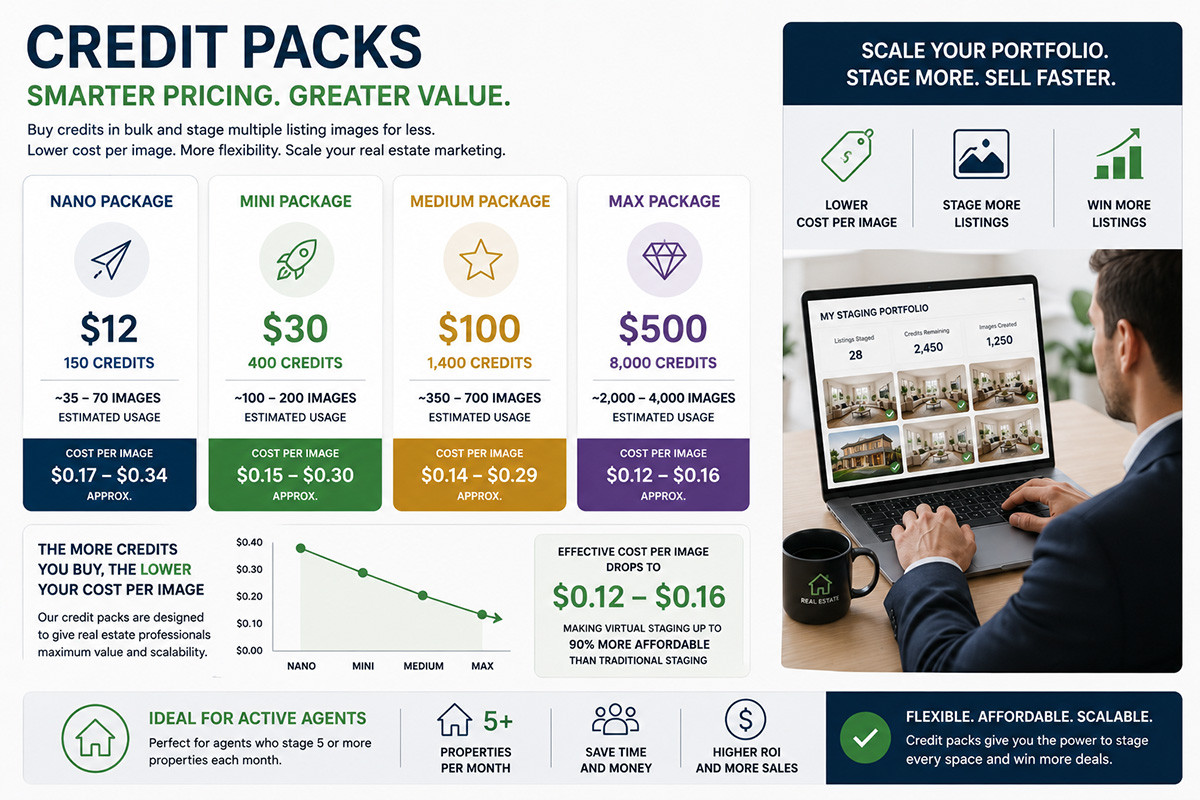
Virtual staging credit pack pricing model showing bulk credits, lower cost per image, and scalable real estate marketing solutions.
Subscription plans
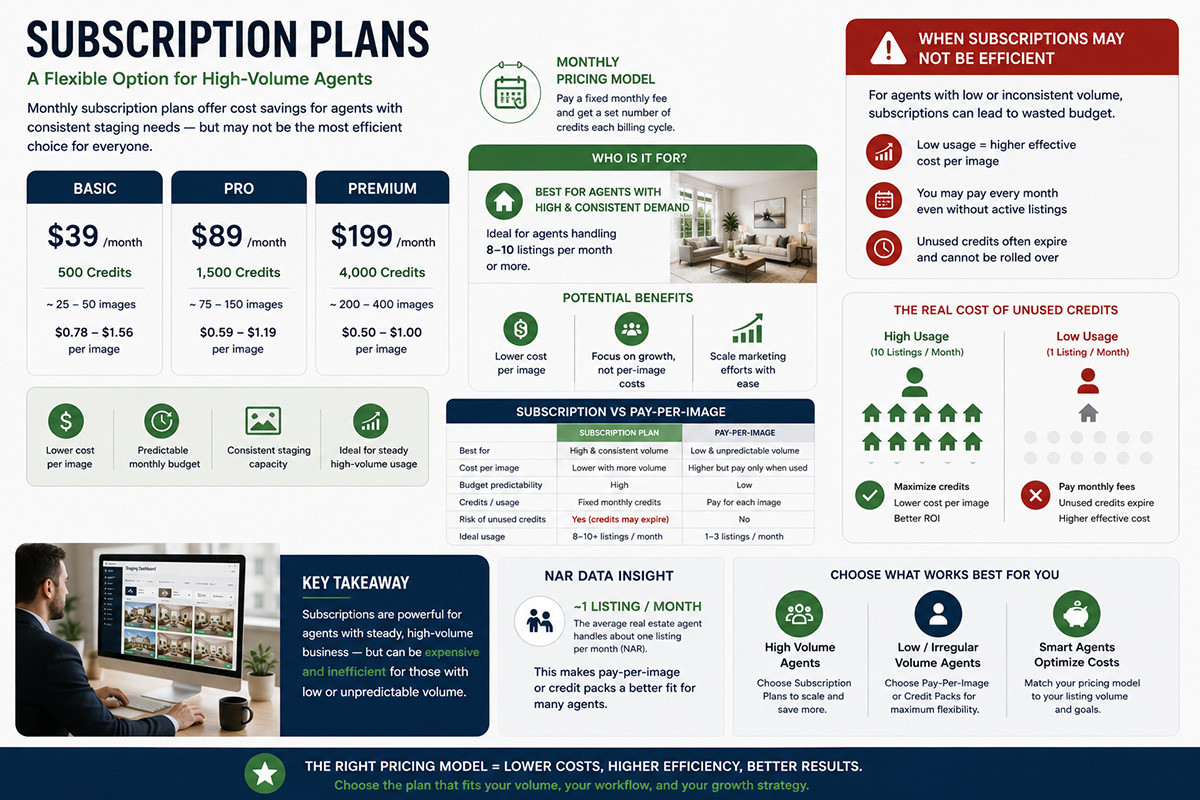
Some virtual staging platforms offer monthly subscription plans as part of their virtual staging pricing, typically ranging from $39 to $199 per month with a fixed number of credits or images included each billing cycle.
While this model can reduce the virtual staging cost per image for agents with high and consistent demand, its real value depends heavily on usage frequency.
It is most suitable for agents handling around 8–10 listings per month, where staging demand is steady. However, many agents work at a lower volume, averaging closer to one listing per month according to NAR data, which makes subscriptions less efficient.
In such cases, users may still pay monthly fees even without active listings, and unused credits often expire, leading to wasted budget and a higher effective virtual staging cost over time.
Subscription plans
Average virtual staging cost in 2026
Average virtual staging cost in 2026
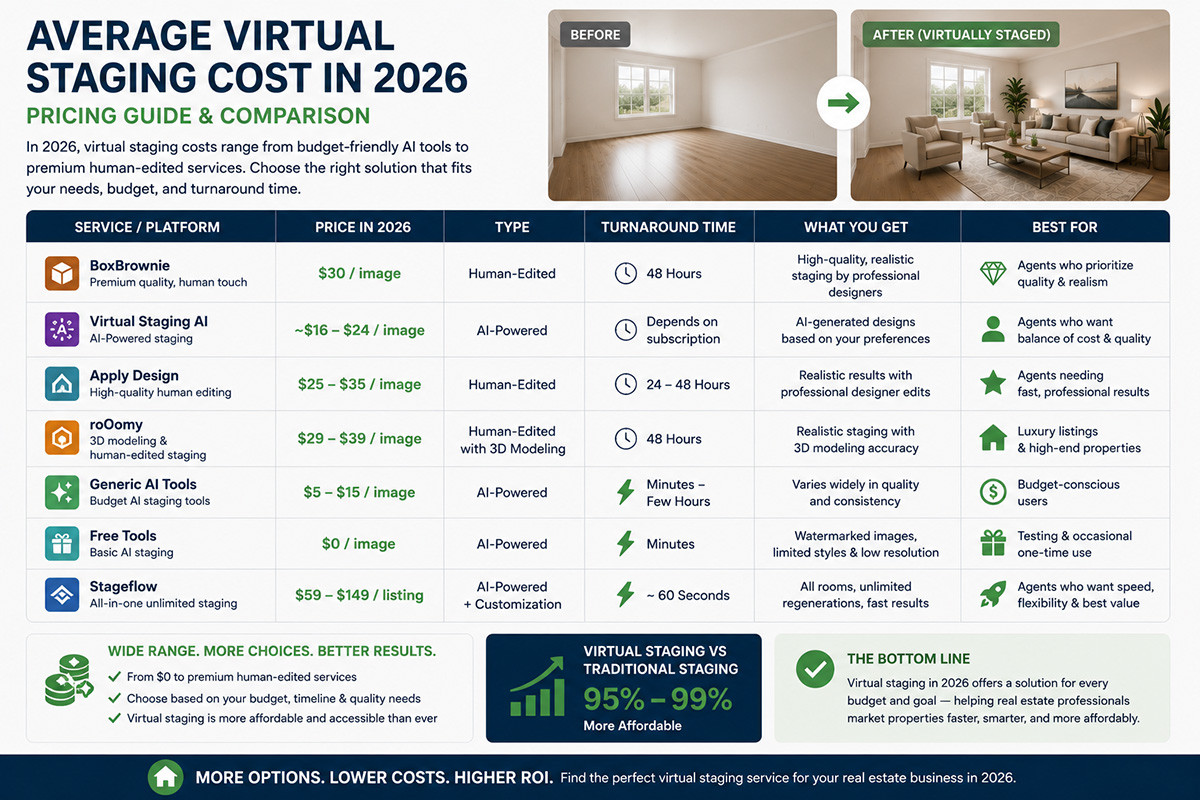
In 2026, the average virtual staging cost varies widely depending on the platform, turnaround time, and level of customization, ranging from budget AI tools to premium human-edited services.
This pricing spectrum makes it easier for agents to choose an affordable staging service that matches both their marketing needs and listing volume.
As the market evolves, virtual staging has become significantly more accessible compared to traditional staging methods.
| Company / Model | Price | What You Get |
| BoxBrownie | $30/image | Human-edited staging, 48-hour turnaround |
| Virtual Staging AI | ~$16-24/image | AI staging, depends on subscription tier |
| Apply Design | $25-35/image | Human-edited, 24-48 hour turnaround |
| roOomy | $29-39/image | Human-edited with 3D modeling |
| Generic AI tools | $5-15/image | Varies wildly in quality |
| Free tools | $0 | Watermarked, limited styles, low resolution |
| Stageflow | $59-$149/listing | All rooms, unlimited regenerations, 60 seconds |
Hidden virtual staging cost to watch for
When doing a staging service comparison, the listed price often does not reflect the true final cost. Understanding these hidden fees is important when deciding is virtual staging worth it for your real estate marketing strategy.
- Revision fees can increase costs significantly
Human-edited services may charge extra for changes, sometimes raising the original price by 50%–100% per image. AI tools may offer unlimited revisions, helping keep costs predictable.
- Rush delivery charges add premium costs
Fast turnaround requests can cost an additional $10–$20 per image or a percentage-based surcharge. AI staging typically avoids this by delivering results in minutes.
- Resolution and file format upgrades
Some providers charge extra for high-resolution or print-ready images, even though these are often required for professional listings.
- Subscription credit limitations
Many plans include non-rolling credits, meaning unused staging capacity expires. Some also require minimum purchases or restrict flexibility with tiered credit systems.
- MLS compliance fees in some services
Extras like watermarking or metadata tagging may be charged separately, despite being essential for listing standards.
Overall, a proper staging service comparison shows that true costs go beyond the advertised price, which is a key consideration when evaluating is virtual staging worth it for long-term use.
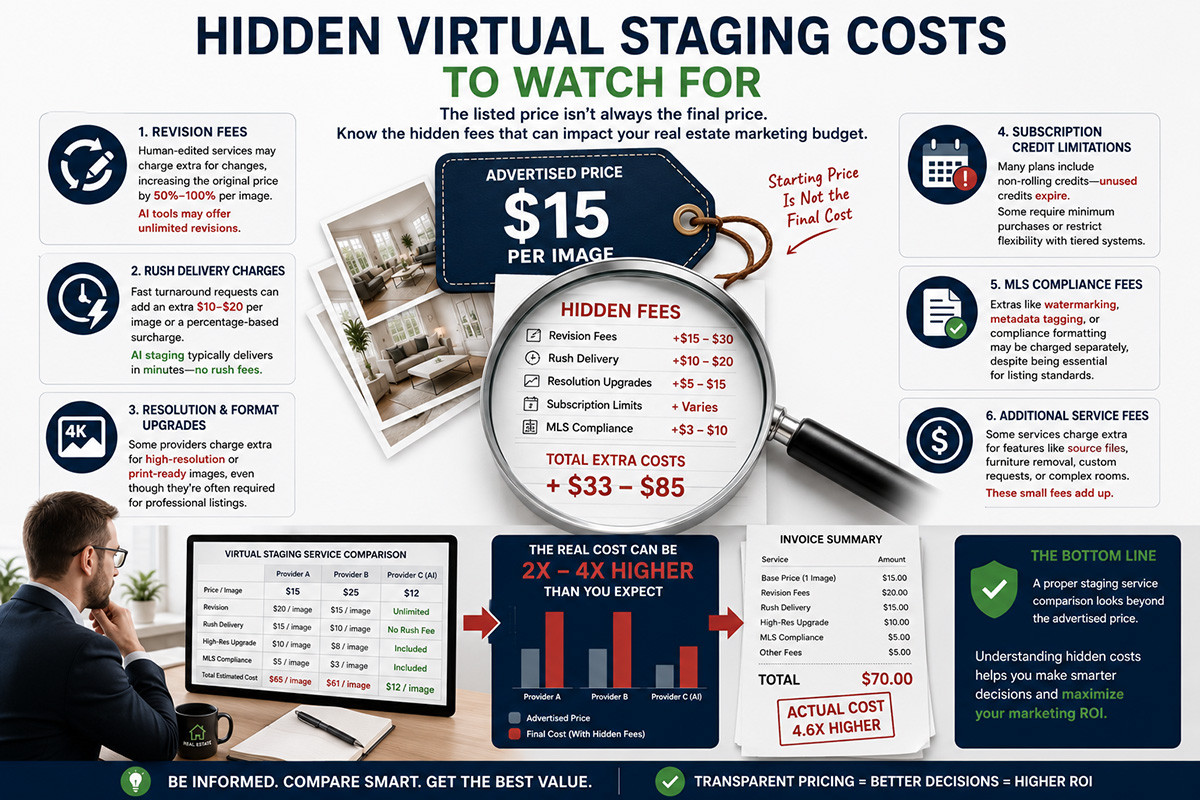
Hidden virtual staging costs including revision fees, rush delivery charges, subscription limitations, and MLS compliance expenses.
To sum up
Understanding the full range of services, hidden fees, and pricing models helps you make smarter marketing decisions. By comparing options carefully, you can balance quality, speed, and budget to get the best results. Managing virtual staging cost effectively ensures higher ROI and more impactful property listings.