

On August 31, 2025, VHT Studios—one of the most recognizable names in the U.S. real estate photography and media industry—officially ceased operations.
For many photographers, editors, brokerages, and media professionals, the announcement marked more than the closure of a company. It signaled the end of an era that helped define how real estate media, photography workflows, and post-production services were delivered at scale for nearly three decades.
The question now is no longer what happened.
The question is what happens next.
For companies, photographers, and real estate photo editing teams worldwide, VHT’s closure represents both uncertainty and opportunity.
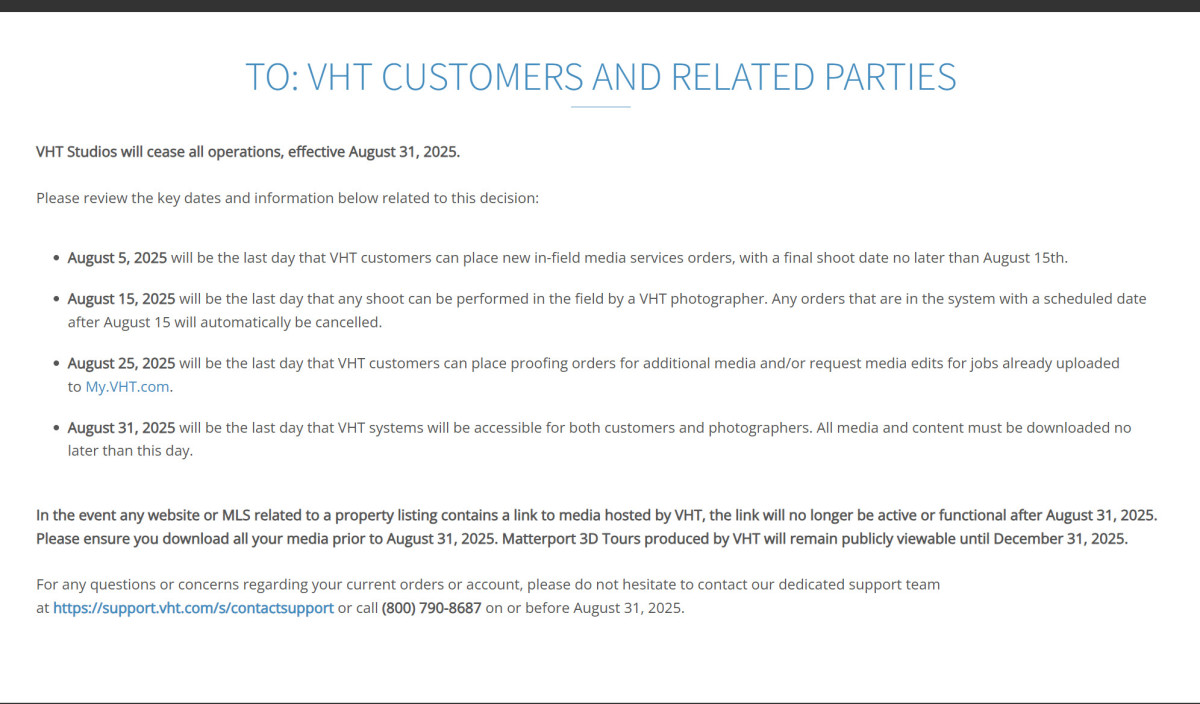
Official announcement on VHT’s website
The Rise of VHT Studios
Founded in 1998, VHT Studios became one of the most influential companies in the U.S. real estate media industry.
Long before modern client portals, cloud-based workflows, and AI-powered editing tools became common, VHT established systems that helped standardize professional real estate photography services across thousands of property listings.
The company built its reputation through:
- Reliable nationwide photography networks
- Consistent editing standards
- Structured production workflows
- Fast delivery processes
- Long-term brokerage partnerships
For many professionals, VHT represented stability.
For photographers, it provided access to consistent assignments.
For editors and production teams, it created predictable workflows and long-term volume.
For brokerages, it offered a trusted solution capable of supporting large-scale operations.
In many ways, VHT helped define what professional real estate marketing visuals should look like.
Why Did VHT Close?
Like many long-established businesses, VHT faced a rapidly changing market.
While no single factor appears to have caused its closure, industry discussions suggest several contributing challenges:
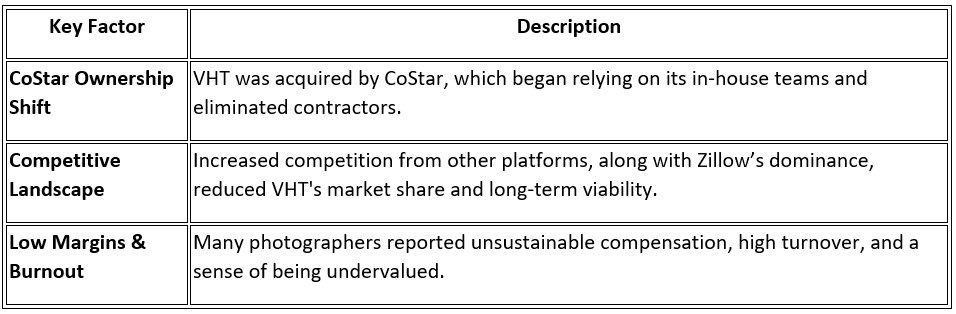
Why Did VHT Close?
Industry Transformation
The real estate photography business has changed dramatically over the past decade.
Today’s clients expect:
- Faster turnaround times
- Flexible editing styles
- Online ordering systems
- Integrated video services
- Mobile-first experiences
Legacy systems that once created competitive advantages can become difficult to adapt as market expectations evolve.
Increased Competition
The rise of independent photographers, boutique agencies, global outsourcing teams, and technology-driven providers has significantly increased competition.
Today, agents and brokerages have access to a wider range of real estate editing services than ever before.
Technology and AI
AI-assisted editing tools continue to reduce production costs and accelerate workflows.
While human expertise remains essential for quality control and brand consistency, automation has fundamentally changed how photo editing services are delivered.
Evolving Workforce Expectations
Both photographers and editors increasingly seek flexibility, direct client relationships, and greater control over their businesses.
Traditional large-scale production models face new pressures in an increasingly decentralized market.
Combined, these factors created an environment that became increasingly difficult for legacy organizations to navigate.
The Industry Gap VHT Leaves Behind
VHT was never simply another real estate media company.
It was a company that helped build the infrastructure of the modern real estate marketing ecosystem.
Its systems influenced:
- Photography workflows
- Editing standards
- Delivery expectations
- Brokerage relationships
- Production scalability
Now that infrastructure is changing.
And when established structures disappear, new opportunities emerge.
Across the industry, a new generation of providers is stepping forward.
These companies are not attempting to recreate VHT’s exact model.
Instead, they are building:
- Modern client portals
- Flexible service packages
- Faster communication channels
- Automated workflow management
- Customized editing solutions
- Scalable production systems
The future of real estate media may belong less to the largest organizations and more to the most adaptable ones.
What VHT’s Closure Means for Editing Teams in Vietnam
For many years, Vietnam has been an important hub for outsourcing photo editing and post-production services.
Numerous freelance editors, production teams, and specialized companies have supported international clients through real estate photo editing services and image enhancement workflows.
The closure of a major player like VHT creates both challenges and opportunities.
Potential Challenges
- Reduced production volume from legacy partnerships
- Increased competition among editing providers
- Greater pressure on pricing and turnaround expectations
Emerging Opportunities
- More direct relationships with photographers and agencies
- Increased demand for specialized editing services
- Greater visibility for independent editing companies
- New opportunities for workflow innovation and technology adoption
For many teams, this transition may accelerate a broader industry trend toward direct collaboration rather than multi-layer outsourcing structures.
What It Means for LRetouch
As a Vietnam photo editing company, LRetouch views this moment as a reflection of how rapidly the industry continues to evolve.
The expectations of today’s photographers and brokerages are different from those of even five years ago.
Clients increasingly want:
- Transparent communication
- Flexible workflows
- Fast turnaround times
- Consistent quality
- Modern project management tools
This shift aligns closely with the direction many independent editing providers have already been moving toward.
At LRetouch, we have focused on building systems that support scalability without sacrificing personal service.
This includes:
- A centralized Client Portal
- Structured revision management
- Brand-specific editing workflows
- Dedicated communication channels
- Support for growing photography businesses
Our goal is not simply to provide real estate photo editing services, but to help photographers build sustainable businesses through reliable post-production support.

For partners seeking a stable, modern, and human-centered editing solution – LRetouch is ready!
A Broader Lesson for the Industry
Perhaps the most important lesson from VHT’s closure is that no company—regardless of size or history—is immune to change.
The real estate media landscape is evolving faster than ever.
Success increasingly depends on:
- Adaptability
- Client experience
- Workflow efficiency
- Technology integration
- Strong partnerships
The companies that thrive in the next decade will likely be those that combine operational excellence with the flexibility to evolve alongside their clients.
Final Thoughts
The closure of VHT Studios marks the end of a significant chapter in the history of real estate photography and visual marketing.
Its influence on industry standards, production workflows, and service delivery will continue to be felt for years to come.
But every industry transition creates new possibilities.
For photographers, editors, agencies, and real estate photo editing providers, this moment offers an opportunity to rethink workflows, strengthen partnerships, and build more adaptive business models.
VHT helped define the past.
The next generation of companies, photographers, and creative partners will define what comes next.
For those willing to innovate, collaborate, and evolve, the future of the real estate media industry remains full of opportunity.