
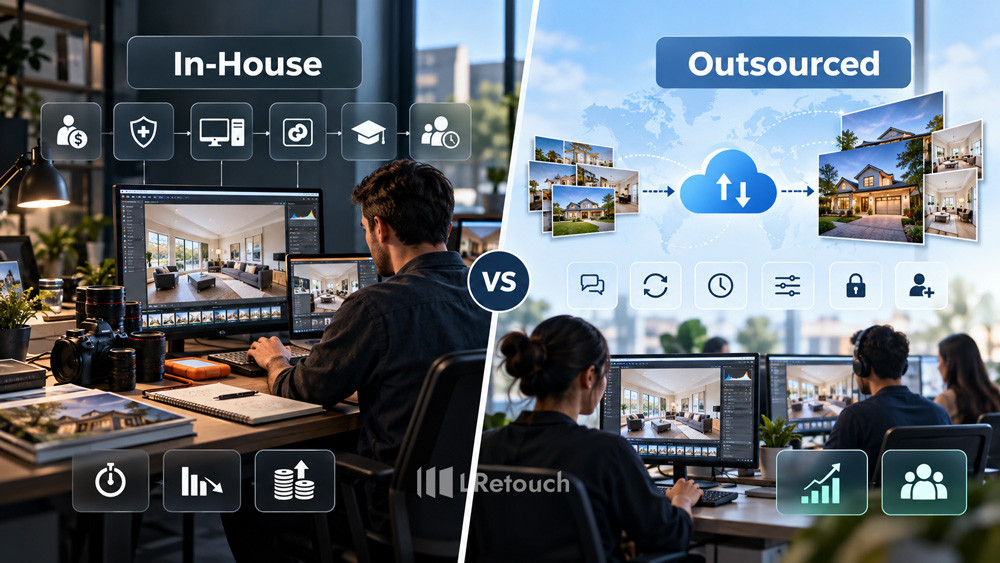
Running a real estate media business requires careful financial planning. Many studio owners debate between hiring an in-house editor or sending projects to an external agency. On paper, fixed salaries look clear. However, unexpected expenses pop up everywhere. Understanding outsourcing editing hidden costs will protect your profit margins and scale your operations smoothly.
In-House Real Estate Editing: Hidden Costs
Building an internal team seems great for direct control. Yet, it can bring many financial surprises. When evaluating options, factoring in the true cost of hiring in house photo editor is essential alongside outsourcing editing hidden costs.
1. Employee Salaries and Benefits
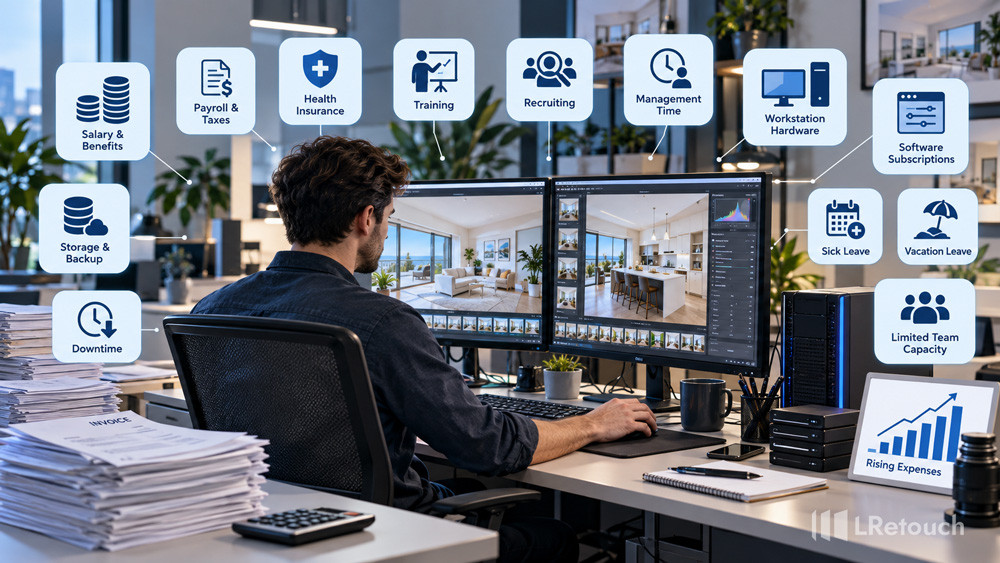
The cost of hiring in house photo editor involves more than the advertised salary. Payroll taxes, health insurance, paid leave, and other employee benefits can increase total compensation costs by 20% to 30%. For example, a $50,000 annual salary could translate into 60,000–65,000 or more in total employment expenses.
2. Hardware and Software Investments
Professional real estate editing requires powerful workstations, dedicated graphics cards, high-speed storage, and reliable backup systems. Businesses must also pay for ongoing software subscriptions, such as Adobe Creative Cloud, and specialized photo retouching or video editing tools. These investments can become substantial, particularly when multiple editors are needed.
In-House Real Estate Editing: Hidden Costs
3. Management and Training Expenses
Recruiting, onboarding, and training editors consume valuable management time. When technical issues arise or editing quality falls below expectations, additional supervision and troubleshooting can further increase operational costs.
4. Downtime and Limited Capacity
In-house editors receive fixed salaries regardless of workload. During slow seasons, businesses may pay for underutilized capacity. Conversely, peak periods can overwhelm a small team, leading to delays and missed deadlines. Vacation days and sick leave can also disrupt production workflows.
5. The Bigger Picture
Although in-house editing offers greater direct control, businesses should evaluate these expenses alongside potential outsourcing editing hidden costs, such as revision fees, rush charges, and communication overhead. Comparing the total cost of ownership—not just hourly rates—helps real estate businesses choose an editing model that balances quality, flexibility, and profitability.
Outsourcing Editing Hidden Costs
Outsourcing real estate photo and video editing helps businesses reduce fixed labor costs, avoid expensive hardware investments, and scale production more flexibly.
For companies looking to outsource real estate photo editing projects, pricing typically ranges from $0.20 to $2.25 or more per photo, while dedicated offshore editing teams may start at around $600 per month. However, these rates may not reflect the full cost of outsourcing.

Outsourcing Editing Hidden Costs
Understanding the outsourcing editing hidden costs, including revision fees, communication overhead, and quality control, helps real estate businesses make informed decisions, manage budgets, and maintain profitability.
1. Communication and Management Overhead
Working with an external editing team requires clear instructions, organized file delivery, and ongoing communication. Businesses must spend time preparing briefs, explaining brand guidelines, and coordinating deadlines. Time-zone differences can also slow responses and approvals. These real estate editing overhead expenses may increase when projects require frequent clarification or hands-on supervision.
2. Revision Cycles and Delivery Delays
Even experienced editors may occasionally miss specific requirements, such as window pulls, accurate color balance, or straight vertical lines. Each revision adds another round of feedback, quality checks, and file transfers. If corrections take 24–48 hours, businesses risk missing client deadlines. Rush delivery fees may create additional expenses when turnaround times become critical.
3. Inconsistent Editing Styles
When multiple editors handle the same account, maintaining consistent colors, brightness, and retouching standards can be challenging. Without established presets, detailed guidelines, and a reliable quality-control process, businesses may need to spend extra time reviewing and correcting final images. Working with a dedicated editor can reduce this risk, although it may come with different pricing or capacity limitations.
4. Security and File Transfer Costs
Real estate editing involves transferring high-resolution images, video footage, and sometimes confidential property information. Businesses may need secure file-sharing platforms, additional cloud storage, encrypted transfer methods, and non-disclosure agreements (NDAs) for sensitive listings. These requirements should be included in agency budgeting, particularly when handling luxury properties or large volumes of client data.
5. Vendor Switching and Onboarding
If an editing provider’s quality declines or communication becomes unreliable, switching vendors involves more than finding a lower price. Businesses must evaluate alternatives, test editing samples, document workflows, and train the new team on their preferred style. During the transition, productivity may temporarily decrease.
Quick Comparison Hidden Cost Of In-House Vs Outsourced Real Estate Editing
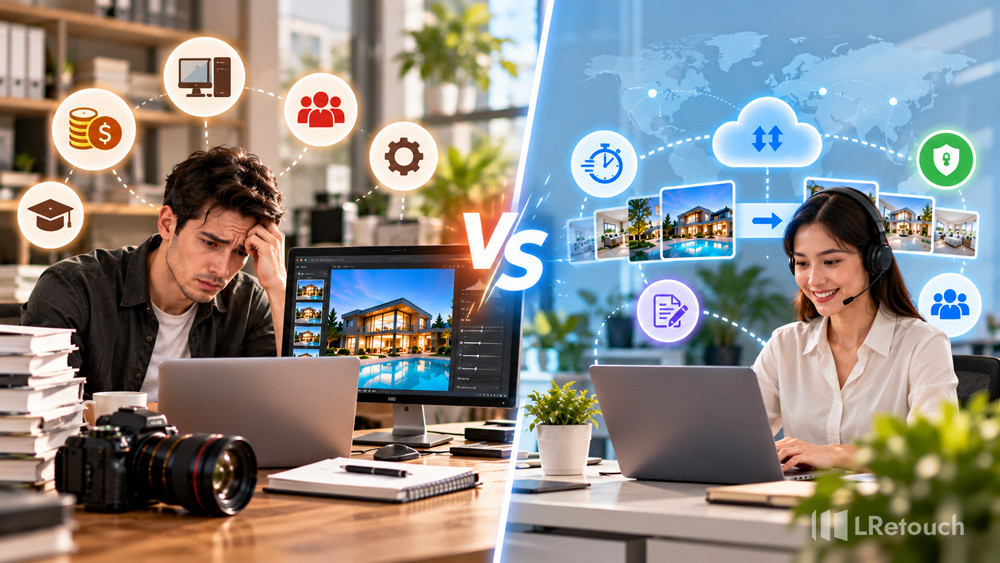
Choosing between in-house and outsourced editing depends on your workload, budget, and growth goals. While in-house editing involves fixed employee and equipment expenses, outsourcing replaces many of these costs with variable service fees. However, outsourcing editing hidden costs—including revisions, communication, and quality control—should also factor into your decision.
| Cost Factor | In-House Editing | Outsourced Editing |
| Cost Structure | Fixed salaries, benefits, hardware, and software | Per-image fees or monthly retainers |
| Hidden Expenses | Recruitment, training, maintenance, and idle capacity | Project management, revisions, file transfers, and vendor onboarding |
| Scalability | Requires additional staff and equipment to expand | Adjusts more easily to changing workloads |
| Turnaround Time | Direct control over priorities and internal queues
Immediate / same-desk control |
Depends on workload, provider capacity, and agreed SLA
Typically 24 to 48 hours (or extra fee for rush 12-hour return) |
| Best suited for | Businesses with consistent, high-volume editing workloads | Growing photographers wanting to reallocate hours to high-ROI shooting ($200+/hr vs $26/hr editing) |
In-house editing can be cost-effective when your business has a steady stream of projects that keeps editors fully utilized. However, salaries, benefits, software, and equipment remain ongoing expenses during slower periods.
Quick Comparison Hidden Cost Of In-House Vs Outsourced Real Estate Editing
Outsourcing allows you to outsource photo editing without committing to the full cost of an internal production team. It can reduce fixed overhead and accommodate seasonal demand, although revision fees, communication time, and vendor reliability may affect the final cost.
The bottom line
Choosing the right editing model means looking beyond upfront rates. By understanding outsourcing editing hidden costs, you can control expenses, maintain quality, and scale your real estate photography business sustainably.