
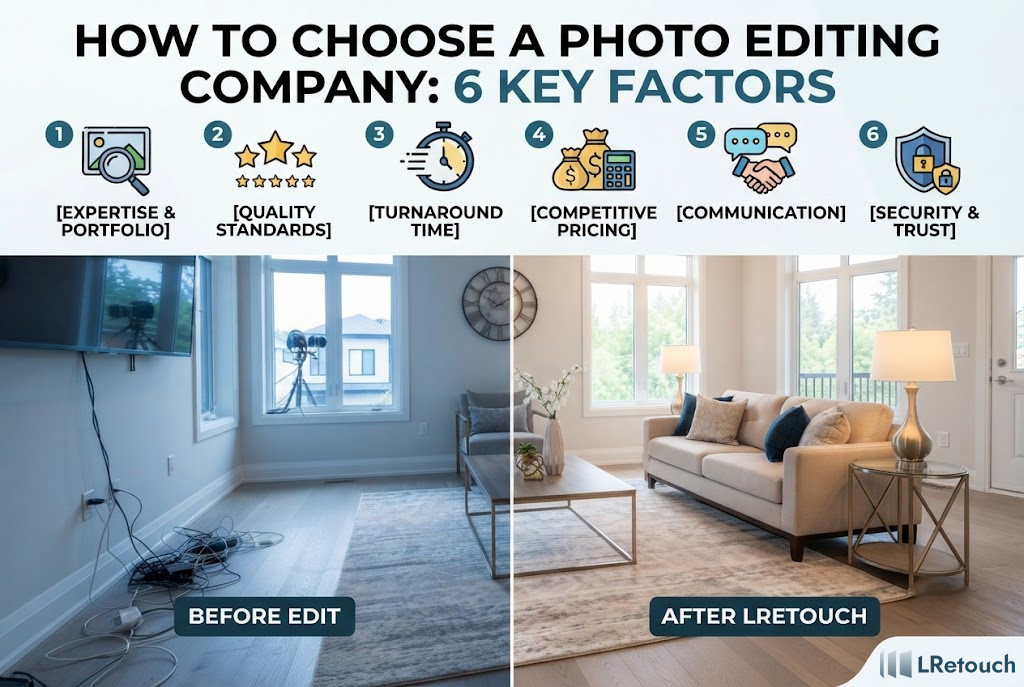
Knowing how to choose photo editing company can help you improve image quality, save time, and control editing costs. The right provider should match your needs, budget, quality standards, and deadlines. This guide covers the key factors to check before choosing a photo editing service.
Different types of real estate photo editing services
High-quality property photos can attract buyers and increase listing engagement. Real estate photo editing helps photographers, agents, and property owners create clean, attractive, and professional images.
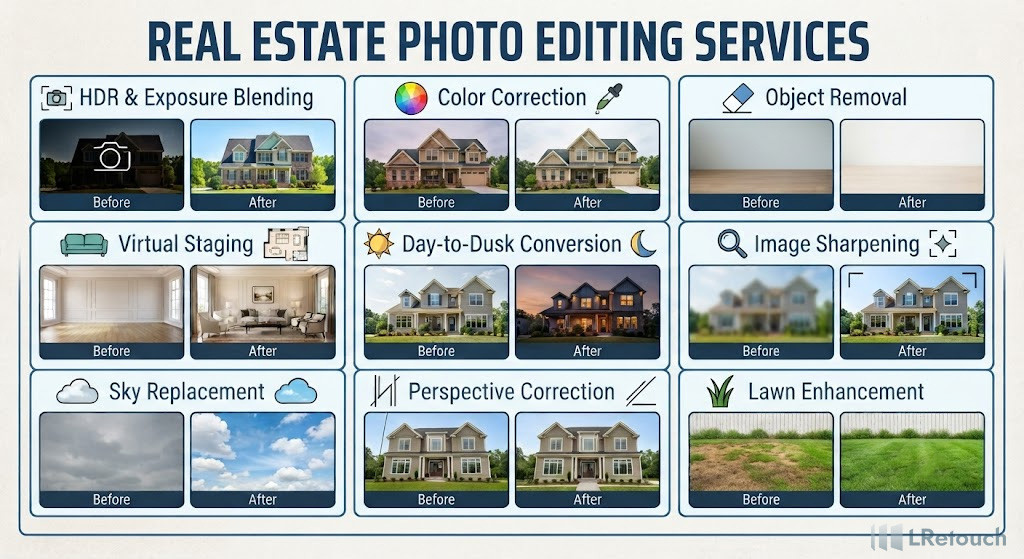
Here are the most common types of real estate photo editing services.
- Basic Photo Enhancement: Editors adjust brightness, contrast, sharpness, and exposure. They also crop and straighten images. This creates a balanced and professional look.
- HDR Photo Editing: HDR editing combines multiple exposures into one image. It helps balance bright windows and darker interiors. This technique creates detailed photos with natural-looking lighting.
- Color Correction: Editors fix inaccurate colors caused by different lighting conditions. They adjust white balance, saturation, and color temperature. This helps rooms and outdoor spaces look more natural.
- Sky Replacement: A dull or overcast sky can reduce the visual appeal of a property. Editors can replace it with a clear or attractive sky. They also match the lighting for a realistic result.
- Virtual Staging: Virtual staging adds digital furniture and decorations to empty rooms. It helps buyers understand the room’s potential without physical staging costs.
- Object Removal: Editors remove unwanted items such as cars, trash cans, wires, signs, or personal belongings. This keeps the focus on the property.
- Twilight Photo Editing: Editors transform daytime exterior photos into warm twilight scenes. This style can make homes look more inviting and premium.
Different types of real estate photo editing services
When choosing a photo editing company, consider turnaround time, editing quality, pricing, and revision policies. For agents and photographers handling many listings, affordable real estate photo editing can reduce costs while maintaining consistent image quality.
How to choose photo editing company?
Choosing the right photo editing company can directly affect your image quality, workflow, and business costs. A reliable provider can handle large volumes, meet deadlines, and maintain consistent results. However, not every company offers the same quality or service.
Before you choose photo editing company, look beyond price. Evaluate its experience, editing quality, turnaround time, communication, security, and ability to support your long-term needs.
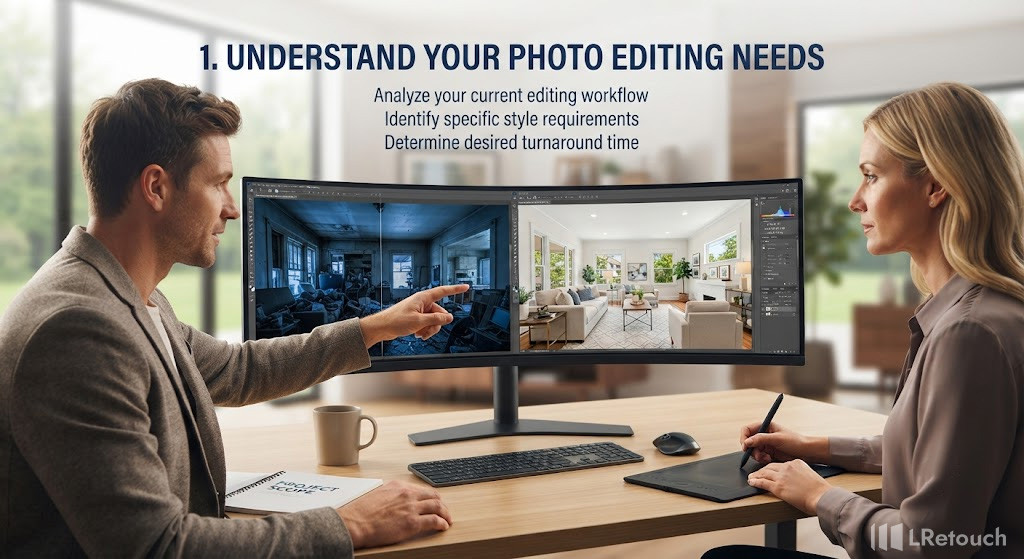
1. Understand Your Photo Editing Needs
Start by defining exactly what you need. Different industries require different editing techniques. A real estate business may need HDR blending, virtual staging, sky replacement, and perspective correction. An e-commerce company may need background removal, clipping paths, color correction, and product retouching.
Your image volume also matters. A photographer who sends 50 images per week has different requirements from an agency that processes 1,000 images per month.
Create a simple editing brief before contacting providers. Include your preferred style, file format, resolution, turnaround time, and expected image volume. This makes it easier to select editing provider that fits your workflow.
Understand Your Photo Editing Needs
2. Evaluate the Portfolio and Editing Quality
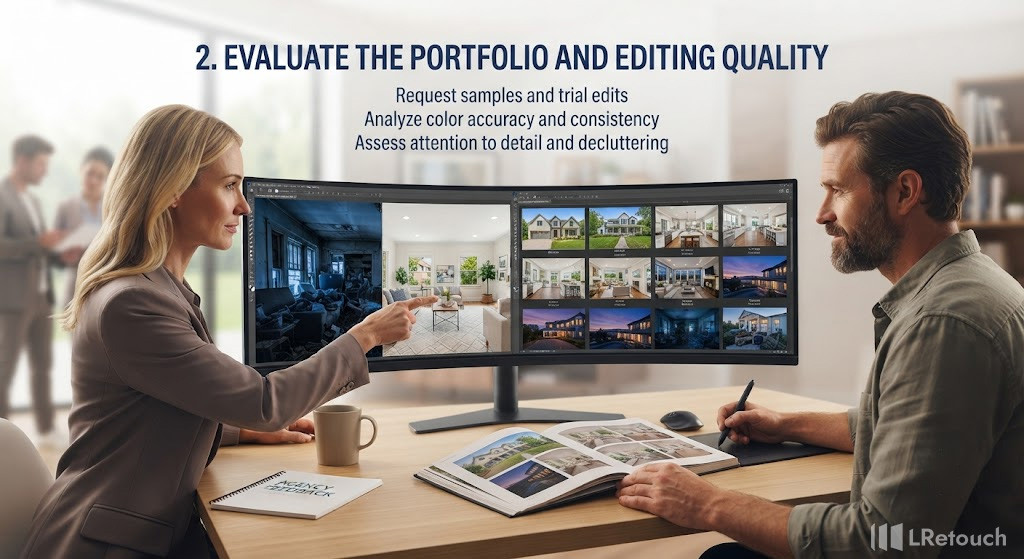
A portfolio is one of the best ways to judge an editing company. Look for work that matches your industry and editing requirements. Do not focus only on attractive images. Examine the technical details.
For real estate photos, check whether the provider maintains natural window views, balanced exposure, straight vertical lines, realistic skies, and accurate colors. Poor HDR blending can create halos around windows. Excessive color correction can also make a property look unrealistic.
Ask for before-and-after samples whenever possible. These samples show what the editor actually changes. They also help you determine whether the editing style matches your brand.
A free trial is even better. Send several representative images instead of one easy image. This gives you a more accurate view of the provider’s consistency.
Evaluate the Portfolio and Editing Quality
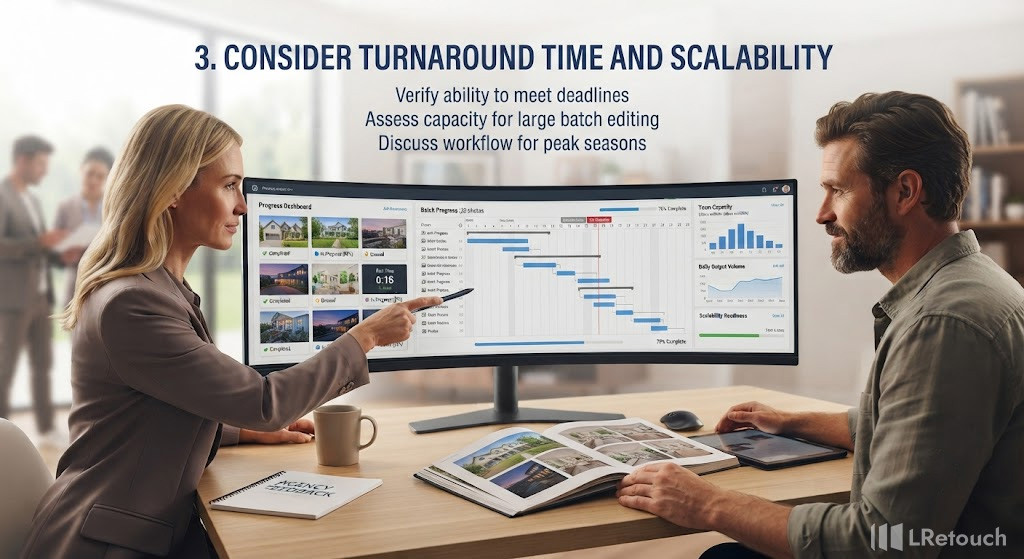
3. Consider Turnaround Time and Scalability
Turnaround time becomes critical when editing supports a regular business workflow. Real estate photographers, for example, may need images ready shortly after a property shoot.
Ask about standard and rush delivery times. More importantly, ask how the company handles bulk orders. A provider may deliver 20 images quickly but struggle with 500 images.
A scalable provider should maintain similar quality during busy periods. It should also have enough trained editors and a quality-control process to handle increased workloads.
Do not choose the fastest service automatically. A short turnaround is only valuable when the final images meet your quality standards.
Consider Turnaround Time and Scalability
4. Compare Pricing With Overall Value
Price is important, but the lowest quote is not always the most affordable option. Low-cost editing can become expensive if you spend additional time correcting mistakes or requesting revisions.
Compare the complete pricing structure. Check whether the quoted price includes basic corrections, revisions, high-resolution exports, and different file formats. Also ask about rush fees and charges for advanced editing.
For businesses looking for affordable real estate photo editing, bulk pricing can provide better value. Monthly packages may also work well for photographers with predictable image volumes.
The goal is to find a provider that offers a good balance between cost, quality, and reliability.

Compare Pricing With Overall Value
5. Check Experience, Reviews
Choose a provider with experience in your industry. For real estate, check skills in HDR editing, sky replacement, virtual staging, and perspective correction.
Read an editing company review to assess quality, communication, turnaround time, and reliability. Compare independent feedback rather than relying only on website testimonials.
For Vietnam vs India photo editing, compare providers based on quality, price, communication, security, and scalability. Send the same sample images to several companies. Compare the results to find the best editing service for your needs.

Check Experience, Reviews
6. Test the Provider Before a Long-Term Contract
Do not start with a large project immediately. Begin with a small batch of representative images. Use this stage to evaluate quality, communication, delivery speed, and revision handling.
A strong best editing service should perform well across all four areas. If the provider delivers good samples but struggles with communication or deadlines, it may not be suitable for long-term work.
After the trial, review the results against your original requirements. If the company consistently meets your standards, you can gradually increase the workload.

Test the Provider Before a Long-Term Contract
Common mistakes to avoid when selecting editing provider
Choosing the wrong editing provider can lead to poor image quality, missed deadlines, and unexpected costs. Avoid these common mistakes when you choose photo editing company for your business.
- Choosing based only on price: The cheapest service may deliver inconsistent results. Compare quality, turnaround time, revisions, and overall value.
- Skipping a trial: Always test the provider before sending a large batch. A trial shows whether the editor can follow your instructions and match your preferred style.
- Ignoring reviews: Read an editing company review from independent sources. Look for feedback about quality, communication, deadlines, and customer support.
- Not checking industry experience: Different industries need different editing skills. Real estate projects may require HDR blending, sky replacement, and virtual staging.
- Overlooking security: Make sure the provider protects your images and business information. Ask about secure file transfers, data storage, and confidentiality.
- Failing to clarify pricing: Ask about revisions, rush orders, and additional fees before starting.
One of the most useful outsource editing tips is to compare several providers using the same sample images. This makes quality, pricing, and service differences easier to identify.

Common mistakes to avoid when selecting editing provider
To sum up
The right photo editing provider can improve quality, save time, and reduce costs. Compare quality, pricing, experience, turnaround time, security, and reviews. Start with a trial before making a long-term decision. Take time to choose photo editing company that fits your needs.