
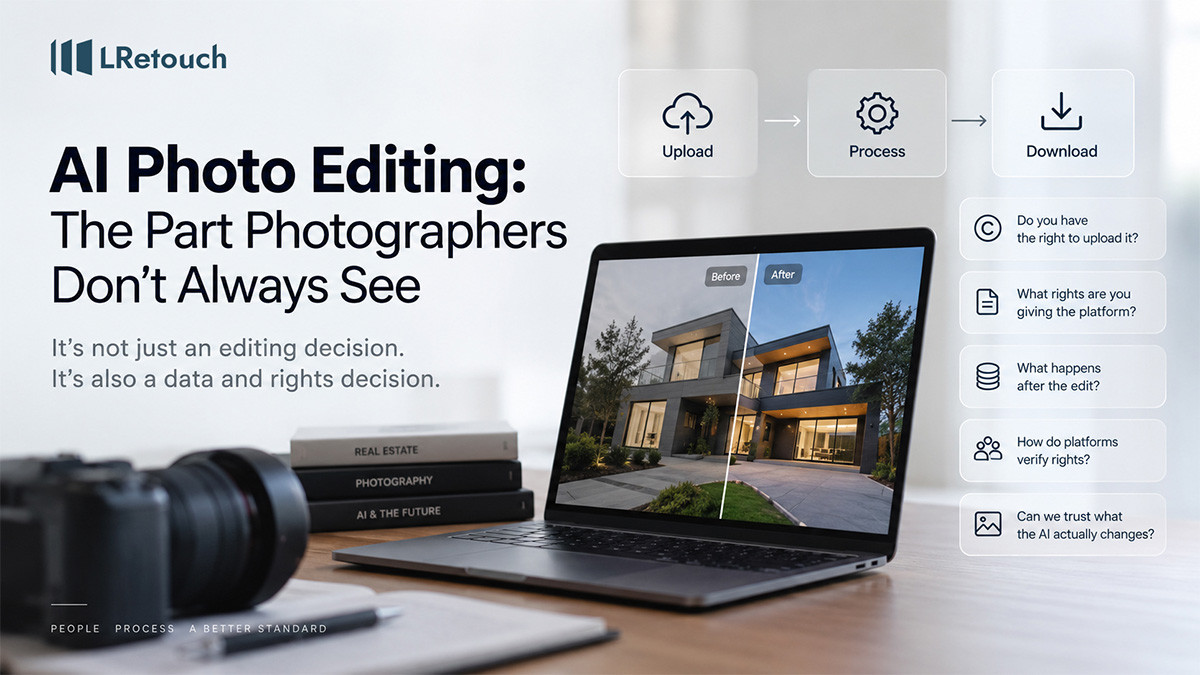
The visible part of AI real estate photo editing is seamless: Upload, process, and download. A photographer submits property photos, an automated system enhances them, and polished listing images return within seconds.
However, beneath those three simple steps lies a complex legal and logistical network. As automated tools redefine real estate post-production, the source image moves from a creator’s closed workflow into a third-party system, sparking crucial questions that go far beyond visual quality.
-
Who holds the legal right to upload the property image?
-
What licensing rights are implicitly granted to the AI photo editing platform?
-
How do AI image training data rights impact your original photography catalog?
-
Who is ultimately accountable if copyright boundaries are crossed?
The Origin Story: Ownership Before the Upload
The conversation surrounding AI photography copyright does not start when a file lands on a server; it begins long before the upload. Real estate media typically travels through a massive chain of custody:
Photographer → Real Estate Agent → Brokerage → MLS → Property Listing Websites → Social media → Third party platforms
The person uploading an image to an automated processing tool is frequently not the original creator. As discussed by industry leaders on the PropMedia Podcast, platforms face a valid dilemma: How can an automated system verify that the user actually owns the rights to process the file? Simply downloading or accessing an image online does not confer the legal right to run it through an AI real estate photo editing algorithm.
Decoding the Fine Print: Terms of Service and Data Rights
Assuming the upload is authorized, photographers must closely examine the platform’s AI photo editing terms of service. Not all software licenses are created equal:
-
Ownership vs. License: While services like AutoHDR allow users to retain full ownership, their terms often grant the company a broad license to store, reproduce, modify, and process content—explicitly including AI model development and machine learning training.
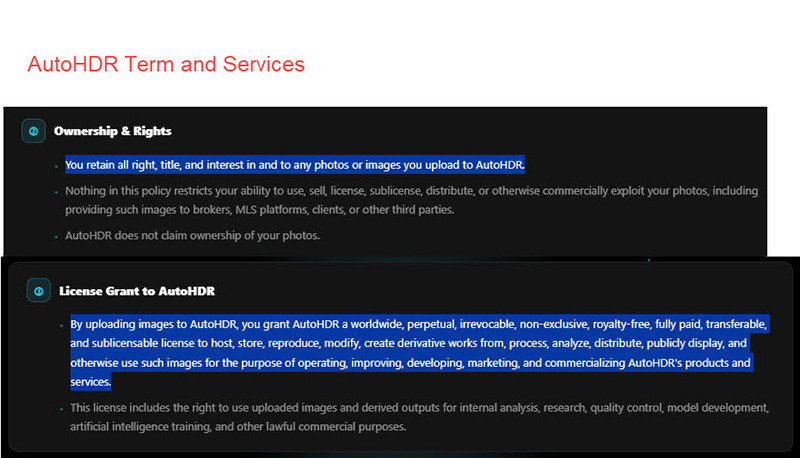
License Grant to AutoHDR
-
Personalized Styles: Other platforms, such as Fotello, focus on non-exclusive licenses strictly designated to analyze photos for building a user’s Personalized Style, alongside utilizing aggregated data to improve general algorithms.
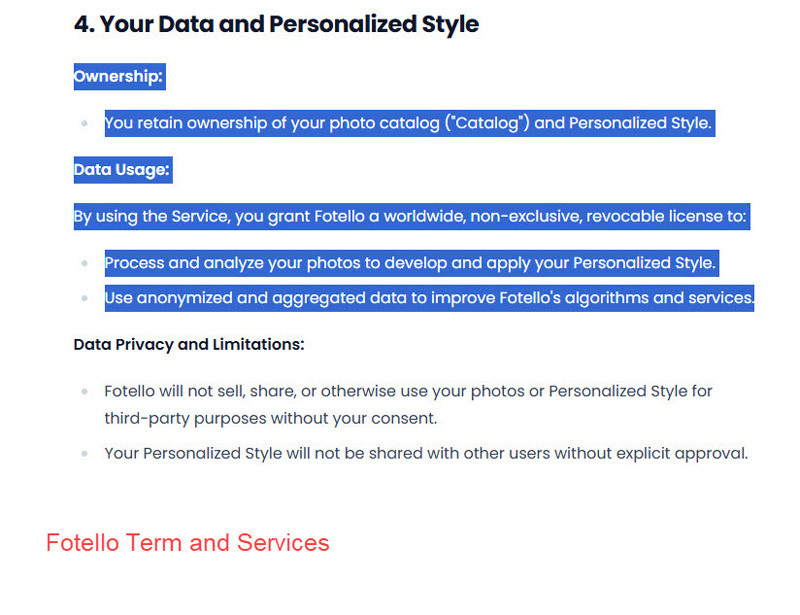
Your Data and Personalized Style
The core takeaway for professionals is simple: Asking “Do I still own my photos?” is no longer enough. The more vital question is, “What am I allowing the platform to do with my data?”
Data Retention and the Lifecycle of an Edited Image
The workflow rarely halts at download. Source files, high-resolution outputs, backup archives, and derived analytics often persist on external servers.
Different providers maintain varying retention schedules. Some retain data strictly as long as necessary to fulfill service obligations, while others keep anonymized and aggregated information indefinitely. Photographers must clarify what terms like “your data” encompass—whether it covers raw source files, metadata, custom presets, or structural derivatives. Protecting data privacy in AI photo editors requires understanding these long-term digital footprints.
The Integrity of the Image: Balancing Enhancement and Reality
Beyond legal agreements, automated processing introduces technical and ethical considerations regarding visual integrity. Real estate marketing relies on accuracy. If an automated tool accidentally alters structural elements, modifies windows, or inserts unrequested fixtures during enhancement, the final asset may compromise listing accuracy and consumer trust.
Trust is multifaceted: it involves both how a platform handles intellectual property and how faithfully it preserves the reality of the property itself.
Essential Questions Every Photographer Should Ask
Embracing automated tools offers unmatched speed, consistency, and efficiency in modern media workflows. Rather than avoiding technology, professionals should evaluate platforms using a rigorous checklist:
-
Do I retain absolute ownership of my source photos?
-
What specific license am I granting the platform under their AI photo editing terms of service?
-
Can my source files or derived derivatives be used for machine learning and AI model training?
-
What are the platform’s data retention policies for backups, outputs, and anonymized information?
-
Can I easily request complete data deletion?
An AI-driven editing platform is never “just another piece of software.” It is an active participant in the commercial lifecycle of your visual assets—from the camera sensor to the final listing. Mastering that journey is just as critical as mastering the technology itself.