
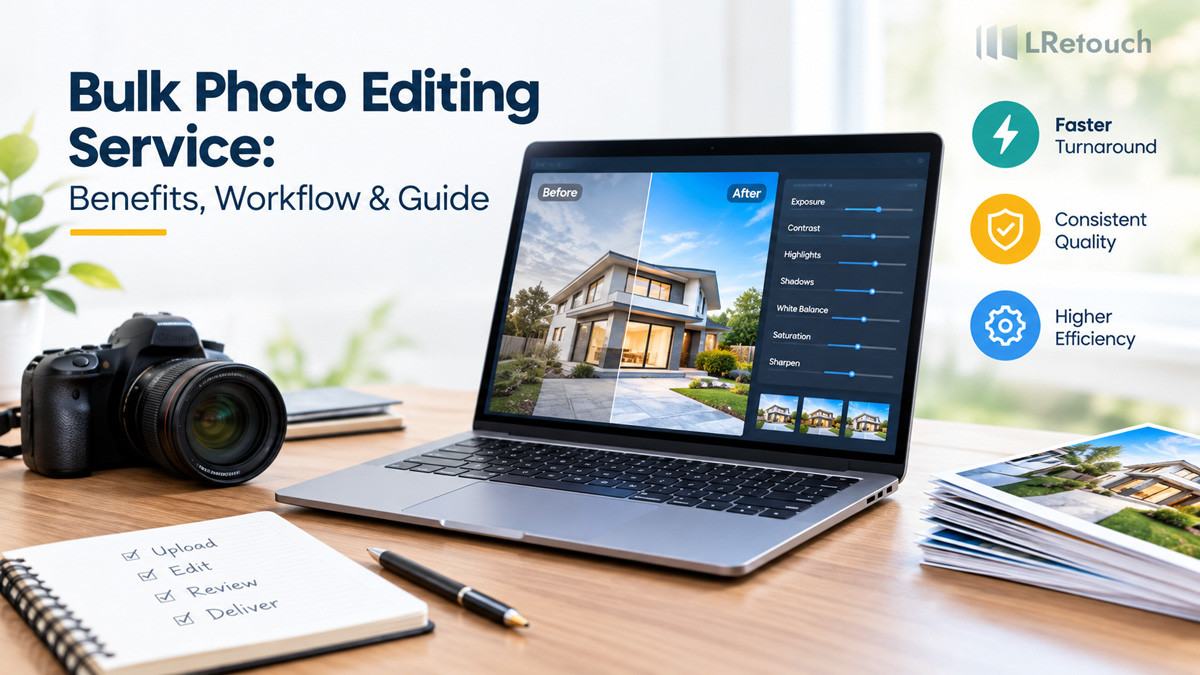
A bulk photo editing service helps photographers and businesses process large image collections quickly. It applies consistent edits across many photos while reducing repetitive work. This approach is useful for real estate photographers, agencies, studios, and marketing teams.
What Is a Bulk Photo Editing Service?
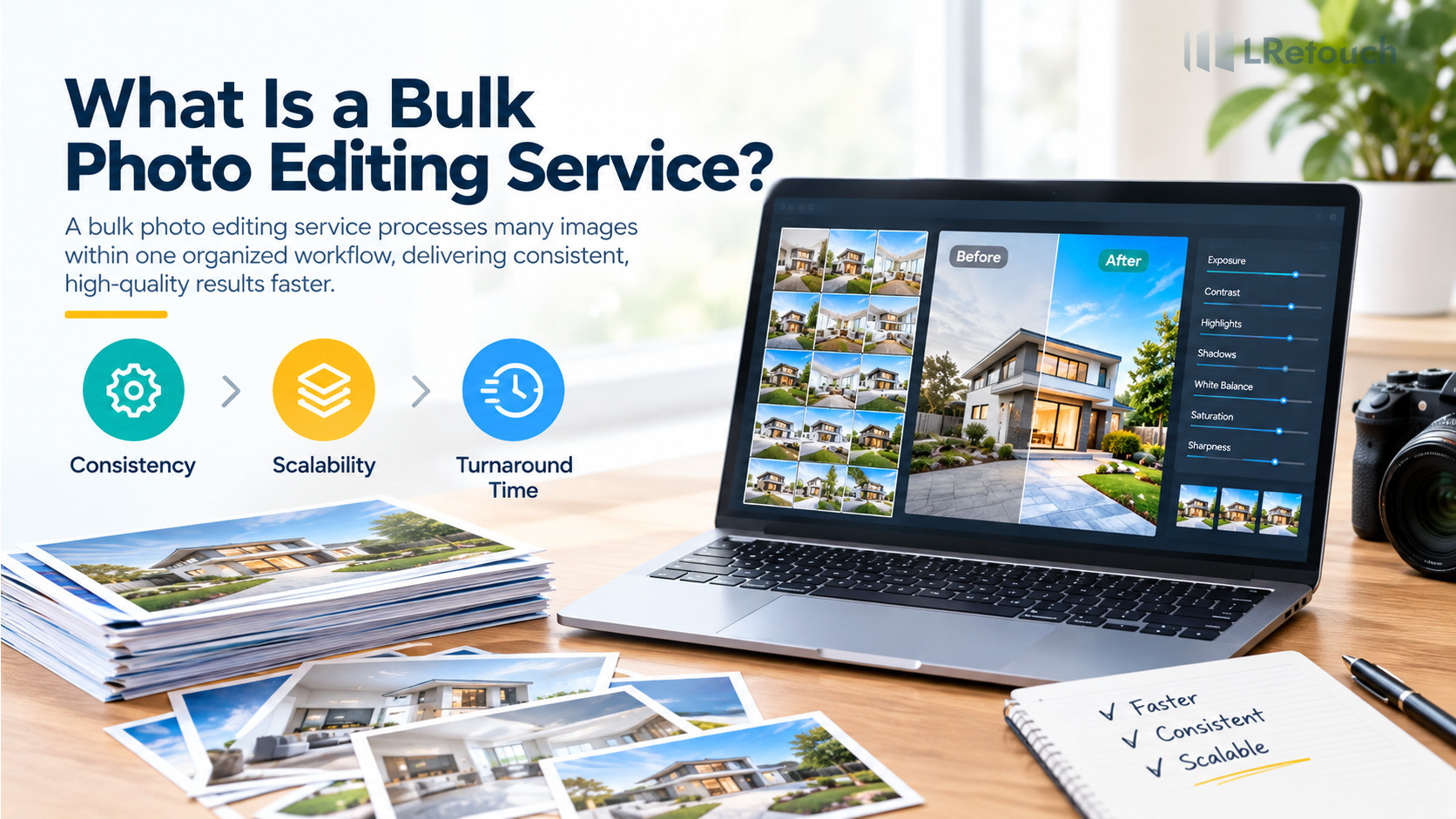
A bulk photo editing service processes many images within one organized workflow. Instead of editing every image from scratch, editors use shared settings and standardized instructions.
The process can handle hundreds or thousands of images. Flatworld Solutions highlights three key factors for bulk editing: consistency, scalability, and turnaround time. It also describes automated workflows for repetitive tasks.
What Is a Bulk Photo Editing Service?
For example, a real estate photographer may shoot 50 images for one property. Each image may need exposure correction, color adjustment, and perspective correction.
Editing them individually can take several hours. A bulk workflow applies common corrections across the full set. Editors then review images that require special attention.
This creates a faster and more consistent process.
Why Businesses Need High Volume Editing
Photo volume can grow quickly for professional photographers. A single client may require dozens of edited images. Large agencies may handle several properties each day.
Manual editing becomes difficult as workloads increase.
High volume editing helps businesses manage this demand without adding the same amount of internal labor.
Why Businesses Need High Volume Editing
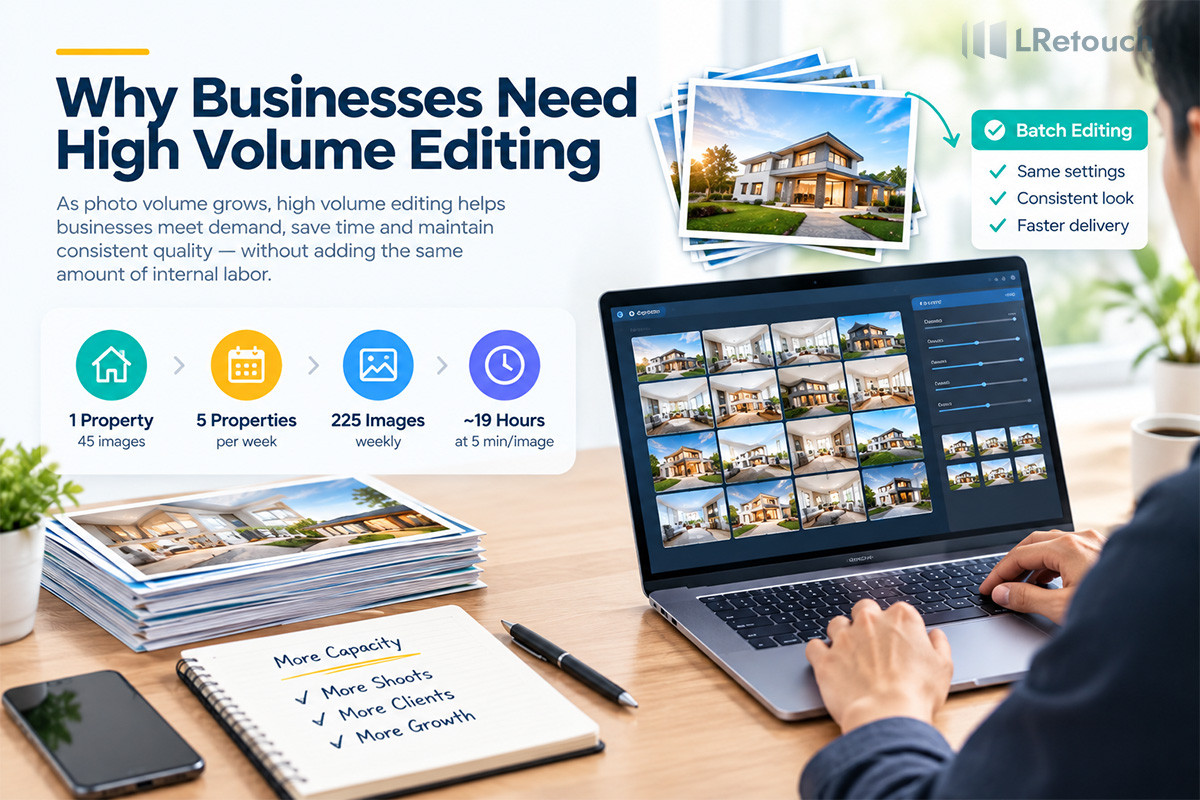
Consider this example:
- One property produces 45 final images.
- A photographer handles 5 properties per week.
- That creates 225 images weekly.
- At 5 minutes per image, editing takes nearly 19 hours.
A batch workflow can reduce repetitive adjustments. Editors can synchronize suitable corrections across similar images. Individual images can then receive targeted retouching.
The exact time savings depend on image complexity and editing requirements. Simple color corrections benefit more from batch processing than complex composites.
Key Benefits of Bulk Photo Editing
1. Faster Turnaround
Speed is one of the main benefits of bulk editing.
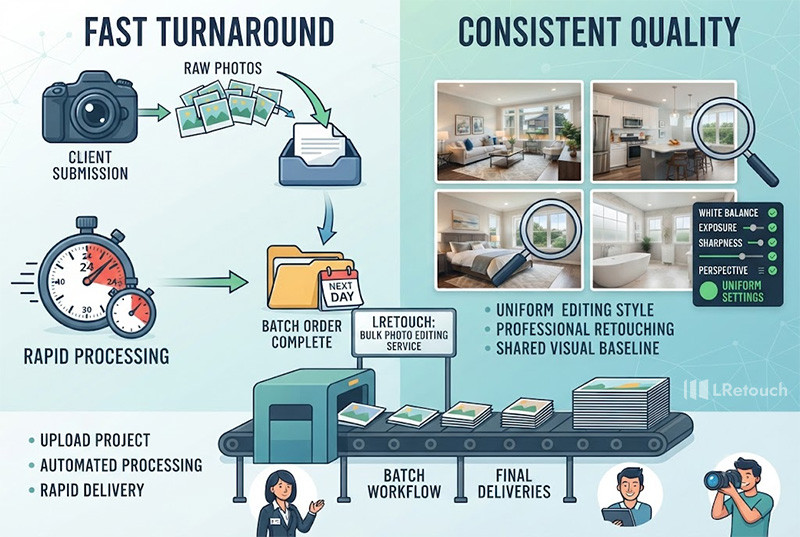
Photographers can submit an entire project instead of sending images separately. Editors process the collection as one organized order.
Some providers advertise 24-hour turnaround for bulk projects. Turnaround depends on image volume, editing complexity, and provider capacity.
Faster delivery can help photographers meet demanding client deadlines.
For example, an agent may need listing photos the morning after a property shoot. A streamlined workflow can make that deadline easier to manage.
2. Consistent Image Quality
Consistency is important when images appear together.
A property gallery should not have one image with a warm color cast. Another image should not appear noticeably darker.
Batch editing creates a shared visual baseline.
Editors can apply consistent settings for:
- White balance
- Exposure
- Contrast
- Color
- Sharpness
- Lens correction
- Image dimensions
However, not every image should receive identical adjustments. Different rooms can have different lighting conditions.
Professional workflows therefore combine batch corrections with individual review.
Key Benefits of Bulk Photo Editing
3. Better Workflow Efficiency
Large projects contain many repetitive tasks. These tasks can consume valuable editing hours.
Automation and specialized software can help process repetitive adjustments across image batches. Flatworld Solutions describes automated processing for tasks such as color correction and resizing.
This allows photographers to spend more time on photography and client communication.
When Should You Outsource Bulk Editing?
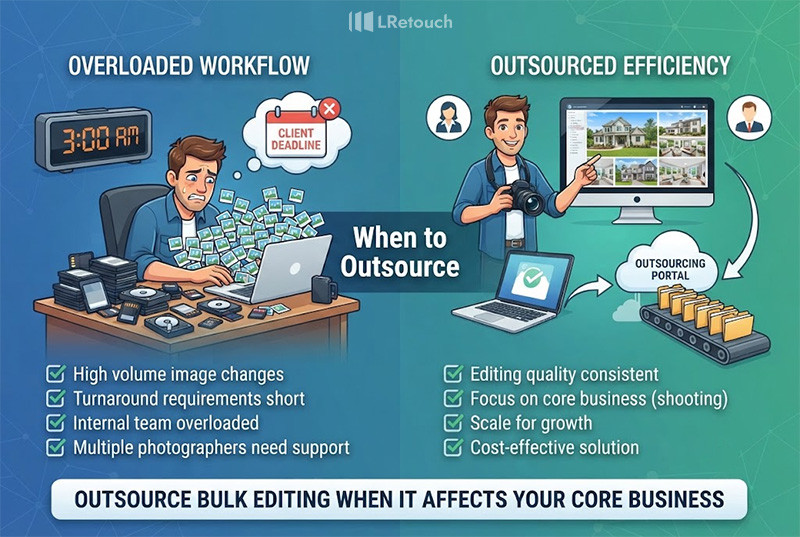
Outsource bulk editing when editing volume begins affecting your core business.
This can happen when photographers spend evenings editing instead of shooting. It can also happen when agencies struggle with listing deadlines.
When Should You Outsource Bulk Editing?
Outsourcing can be useful when:
- Image volume changes from week to week
- Internal editors are overloaded
- Turnaround requirements are short
- Multiple photographers need support
- Editing quality must remain consistent
- Hiring full-time editors is not practical
For example, a photographer may handle 10 property shoots during a busy month. Outsourcing the post-production workload can create additional capacity.
The photographer can focus on shooting and client service.
Real Estate Photo Editing Workflow
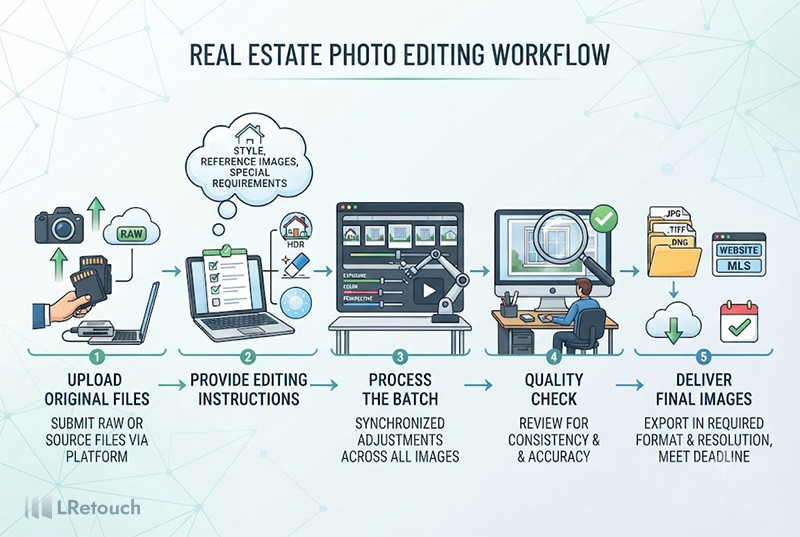
A strong real estate photo editing workflow should be simple and repeatable. A clear process helps photographers manage large batches while maintaining professional quality.
Real Estate Photo Editing Workflow
Step 1: Upload Original Files
Send RAW or other required source files through an approved platform.
If using an upload photo editing service, organize images by property or room and confirm the supported file formats and transfer method.
Step 2: Provide Editing Instructions
Share your preferred editing style, reference images, and any special requirements.
Clearly identify images that need HDR blending, object removal, sky replacement, or other advanced edits.
Step 3: Process the Batch
Editors apply consistent adjustments such as exposure, white balance, color, contrast, and perspective correction.
Individual images can receive additional adjustments when needed.
Step 4: Quality Check
The completed images are reviewed for consistency, accuracy, color balance, and technical issues.
Any necessary revisions should be completed before delivery.
Step 5: Deliver Final Images
Final images are exported in the required format, resolution, and dimensions for MLS listings, websites, social media, or print.
A standardized workflow reduces communication, prevents missed instructions, and makes high-volume real estate photo editing easier to manage..
How to Choose a Bulk Photo Editing Provider
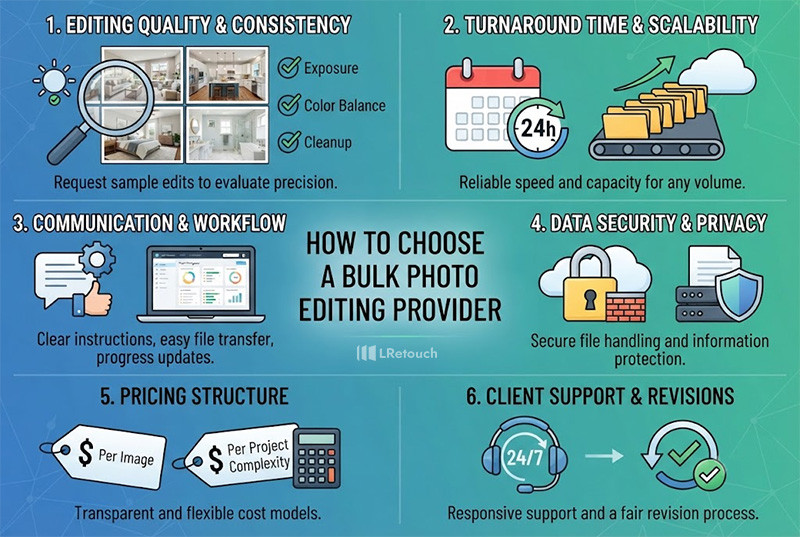
Choosing the right bulk photo editing provider can make a significant difference when you need to process hundreds or thousands of images. The right service should deliver consistent results while meeting your deadlines, quality standards, and budget.
Start by evaluating editing quality and consistency. Ask for sample edits or a trial project to see how the provider handles exposure, color correction, perspective, image cleanup, and other requirements. Consistency is especially important when images from the same photoshoot need to have a uniform appearance.
Next, consider turnaround time and scalability. A reliable provider should be able to handle both regular workloads and larger projects without compromising quality. Ask about standard delivery times, rush options, and how the team manages high-volume orders.
How to Choose a Bulk Photo Editing Provider
Communication and workflow are also important. Look for providers with clear instructions, easy file transfer, progress updates, and a straightforward revision process. This can reduce delays and prevent misunderstandings.
Finally, compare pricing and security. Check whether pricing is per image, per project, or based on editing complexity. Make sure the provider has appropriate measures for protecting your files and client information.
By comparing quality, turnaround time, scalability, communication, pricing, and security, you can choose a bulk photo editing provider that fits your workflow and long-term needs.
Final Thoughts
A bulk photo editing service can help photographers and agencies handle growing image volumes. It combines standardized workflows, batch processing, and quality control to improve efficiency.
The right solution should balance speed, consistency, quality, and cost. For real estate professionals, bulk editing can support faster delivery while keeping every listing visually consistent.